Sleeping With Hands Above Head Spiritual Meaning: 12 Signs, the Starfish Position and the Body’s Side of the Story
You fall asleep in an ordinary tangle and wake flat on your back, both hands up beside the pillow, as though you had spent the night reaching for something. The sleeping with hands above head spiritual meaning is among the most searched body signs in modern spiritual writing, and the tradition reads the posture generously: openness, surrender, trust — a sleeper with nothing guarded and nothing hidden.
This article carries that traditional reading in full: all twelve meanings, one hand set against two, the right arm set against the left. Then it sets beside the omen list the parts the omen lists leave out — what a sleep survey actually recorded about this exact shape, what raised arms do to nerves, shoulders and breathing, and why babies strike the same pose for purely mechanical reasons.
Nothing here is a diagnosis, and nothing is a prediction. The spiritual readings belong to the tradition that prints them; the body record belongs to sleep medicine; and the Bible, as the later sections show, does have lifted hands in it — awake ones, lifted on purpose.
Hands Position While Sleeping and Its Spiritual Connection
Hands are the day’s instruments: they work, gesture, hold on and let go. Spiritual writing on sleep treats the resting hand as the same instrument with the editor dismissed — a placement nobody chose, and therefore, in the tradition’s logic, a placement that tells the truth. Where the hands settle is read as a small map of where the sleeper stands: guarded or open, braced or at ease.
Raised hands draw the strongest reading because of what the posture does to the body’s outline. The arms leave their post along the ribs, the chest lies uncovered, and the whole figure points crown-ward. In the symbolism the tradition works with, an uncovered chest is an undefended heart, and an upward direction is the direction of prayer, appeal and receiving. The sleeping household speaks this language at every level, incidentally — even a cat sleeping above your head carries its own reading on this site.

Why Do I Sleep With My Arms Above My Head?
Almost nobody decides this awake. Sleepers migrate: the body turns, tests, discards and settles, and the position a person wakes in is usually the one the sleeping body kept returning to. The plain drivers are physical. Raised arms open the chest and take pressure off the front of the shoulder. Arms thrown out of the covers shed heat, and a warm sleeper’s body learns that trick quickly. Pillow height plays its part too — a low pillow invites the arms up to make up the difference.
Habit then locks the pattern in. In the best-known survey of sleeping positions, only a small minority of respondents — about one in twenty — said they slept in a different position from night to night. For everyone else the posture is not a message sent nightly; it is furniture the body arranges the same way every evening, which is worth remembering before any single night’s pose is read too hard.

12 Spiritual Meanings of Sleeping With Arms Above Head
Below are the tradition’s twelve readings, carried in full and in its own order. Every one of them is a belief held by modern spiritual writing and is printed as exactly that — an interpretation, not a finding.
1. Spiritual Attunement and Seeking Answers Beyond the Material World
The first reading treats the raised arms as a question asked in the dark. The sleeper is pictured as tuned upward, listening past the material day for an answer the day could not supply. In this reading the posture belongs to people in a searching season — turning a decision over, looking for direction — and the body is said to keep reaching after the mind has gone off duty.
2. Acceptance of Change and Transformation
Here the point is the grip, or rather its absence. Arms above the head are holding nothing, defending nothing, and the tradition reads that looseness as change admitted rather than resisted: old arrangements being set down in sleep before they are set down in life. The same tradition reads a flood in a dream as change arriving faster than its banks can hold; this posture is its quieter cousin, change let in through the door instead.
3. Surrender to the Universe
The white-flag reading. Raised hands are the oldest gesture of giving in that the body owns, and the tradition takes the sleeping version at face value: a person who has stopped wrestling something — an outcome, a grievance, a plan that will not bend — and handed it over for the night, and perhaps for good. Surrender here is not defeat in the tradition’s telling; it is the decision to stop spending strength on what strength cannot move.
4. Spiritual Openness and Trust
A sleeper who leaves the chest uncovered is, in this reading, a sleeper who feels safe. Animals guard the belly and the throat; people cross their arms over both. The posture that does the opposite is read as trust made visible — the body resting as though nothing in the room, or in life, needs bracing against.
5. Indicator of Emotional Openness
This reading moves the same observation indoors. Feelings that are managed all day — held in, smoothed over, postponed — are said to come up in sleep the way the arms do. The posture is taken as the sign of someone whose emotional life is not locked down at night: what is felt is allowed to surface, at least in the hours when nobody is watching.
6. Openness to Divine Energy and Unobstructed Energy Flow
The energy reading, stated in the energy tradition’s own terms: raised arms lengthen the body’s line and, in that framework, clear the channel — nothing folded, nothing crossed, the current imagined as running unimpeded from crown to base. It is the most system-specific of the twelve readings and belongs entirely to the energy model that produced it; it stands here as that model’s claim, not as anatomy.
7. Worry and Subconscious Processing of Stress
The list, to its credit, includes a counter-reading of itself. The same posture is also read as the night shift at work: a mind carrying an unresolved load, turning it over in sleep, the body stretched out under the effort. The night mind that worries in posture worries in pictures too — dreaming about your ex is read in the same processing way, as work rather than prophecy. On this reading the raised arms are not serenity; they are overtime.
8. Connection with Higher Powers and Spiritual Guides
Raised hands are the silhouette of prayer in nearly every tradition that prays, and this reading leans on that resemblance: the sleeper pictured as in contact — with God, with guides, with ancestors, depending on the writer — the arms forming the aerial. Vivid dreams and a sense of being accompanied are the signs the tradition attaches to it.
9. Symbol of Safety and Security Need
The tradition prints this reading in both directions and keeps both. Arms up can mean the sleeper feels secure enough to sprawl undefended — or that some part of them is asking for the security they do not yet feel, the body taking up the posture of a child lifted and held. Which direction applies is left, honestly, to the sleeper’s circumstances rather than to the list.
10. Silence Link to Higher Powers and Letting Go
The quietest reading on the list, under its heading as printed. Where the eighth meaning imagines a call sent upward, this one imagines no call at all: a link that works in silence, the hands raised the way a held note is raised — not asking, not declaring, simply open. Letting go, in this version, is not an act performed but a state rested in.
11. Readiness to Embrace New Opportunities
Arms open and empty are also arms ready to receive, and this reading looks forward rather than up: the sleeper pictured on the threshold of something — work, love, a move, a beginning — with the body’s posture arriving at readiness before the waking mind has agreed to it. It is the most optimistic entry on the list and is usually attached to seasons of visible change.
12. Emotional Release and Connection to Higher Self
The list closes by gathering itself. Release is the theme the other eleven keep circling — of tension, of control, of the day’s held breath — and this final reading names the destination the tradition gives it: the higher self, its term for the self that is calm, honest and unhurried. The raised arms are read as the body travelling toward that part overnight and reporting back at waking.
Meaning of Sleeping With One Hand Above Head Versus Two Hands Above Head
The tradition splits the posture by count. One hand up is read as a half-measure, and affectionately so: one side of the sleeper open, the other still on guard — a person mid-transition, releasing something gradually, keeping a hand on the door. It is the posture the tradition assigns to unfinished business and slow healings.
Two hands up is the full sprawl, and the reading is correspondingly complete: nothing guarded on either side, surrender or trust at full stretch. The body record adds a plainer footnote the omen list omits — the difference between one hand up and two is also, on many mornings, simply the difference between one numb arm and two, which the body section below takes up.
Sleeping With Right Arm Above Head Versus Left Arm Above Head
Modern spiritual writing works with a settled side convention: the right side is made to stand for action, giving and the outer life; the left for receiving, feeling and the inner one. A right arm raised is therefore read as the doing life asking for room — decisions, work, direction. A left arm raised is read as the feeling life doing the same — intuition, grief, affection, the unspoken.
One fence needs stating plainly, because the convention is often printed as though it were ancient: no classical body-sign list grades a sleeping arm by side. The old lists grade twitches, itches and throbs — waking events, watched for — and say nothing about sleep posture at all. The right-left reading of the raised arm is a modern construction, carried here as exactly that.
Sleeping Positions and Their Spiritual Meanings
The tradition reads the whole bed, not just this one posture. Its standard overview, carried as printed:
| Sleeping Position | Possible Spiritual Meaning |
|---|---|
| Arms above head | Openness and release |
| Fetal position | Protection and emotional retreat |
| Sleeping on the back | Receptivity and alignment |
| Sleeping on the stomach | Control and emotional guarding |
| Side sleeping | Balance and connection |
Every row of that table is read against the same backdrop — the dark itself, the one condition all sleepers share. The colour of that backdrop has a canon of its own here: what black means spiritually.
Is There Any Spiritual Benefit of This Sleeping Position?
The benefits the tradition claims are consistent across its writers: waking lighter, dreaming more vividly, a feeling of having set something down in the night. Printed as claims, they are unfalsifiable either way — no instrument measures a benefit defined in spiritual terms, and no such measurement will be claimed here.
What honestly remains is smaller and still worthwhile. People who start noticing how they sleep usually start noticing their sleep itself — its length, its quality, its interruptions — and attention of that kind tends to improve the thing attended to. If the posture sends a reader there, it has done a practical good whatever its spiritual status.
The Starfish: What a Sleep Survey Actually Recorded
Sleep science has a name for this exact shape, and it is a better one than most: the starfish — flat on the back, legs apart, both arms up around the pillow. The name comes from the work of Professor Chris Idzikowski of the Sleep Assessment and Advisory Service, whose survey of 1,000 people sorted sleepers into six named positions and attached a personality sketch to each.
The starfish was the rarest of the six, claimed by about five in every hundred respondents. The sketch the survey reports give it is a kind one: starfish sleepers are described as good listeners, quick to help, and happiest out of the centre of attention. That sketch is given here at its true strength — it is the reading of a survey, not the result of a trial, and the two are not interchangeable.
The honest verdict on the whole enterprise comes from the Sleep Foundation’s own summary of the field: there is little scientific evidence that a preferred sleeping position reliably reveals personality traits, and many of the proposed associations have not been replicated. The starfish reading is a charming piece of survey folklore. It should be enjoyed at exactly that weight and no heavier.

What the Position Does to the Body: Nerves, Shoulders and Breathing
The commonest physical report from arms-above-head sleepers is waking with a dead arm, and its mechanism is ordinary. The nerves that serve the arm leave the neck and thread through a narrow passage at the shoulder; raising the arm stretches those nerves and narrows the passage further. Held for hours, the compression produces the familiar pins and needles — paresthesia — which normally clears within minutes of the arm coming down and the pressure lifting. Cleveland Clinic’s record of thoracic outlet syndrome, the condition in which that same passage is permanently narrowed, notes that its pain typically increases when the affected arm is raised; that is context for why clinicians ask about overhead posture, not a diagnosis of anyone who wakes with a tingling hand.
Breathing is the second consideration, and it belongs to back-sleeping generally. Idzikowski’s survey found the starfish and soldier positions — the two flat-on-the-back shapes — more likely than the others to lead to snoring and a bad night’s sleep; lying flat lets the airway and the stomach’s contents settle backward. Snoring alone is common and usually harmless, but the NHS picture of sleep apnoea is a specific one worth printing whole: loud snoring together with breathing that pauses through the night, gasping or snorting as it restarts, frequent waking, and then daytime sleepiness, poor concentration and a headache on waking. A sleeping posture is not a condition, and this article diagnoses nothing — but where that cluster of signs is present and persistent, the ordinary step is a clinician’s assessment and a sleep study, not a new pillow.

Babies Sleep Hands-Up Too — and It Is Not the Same Story
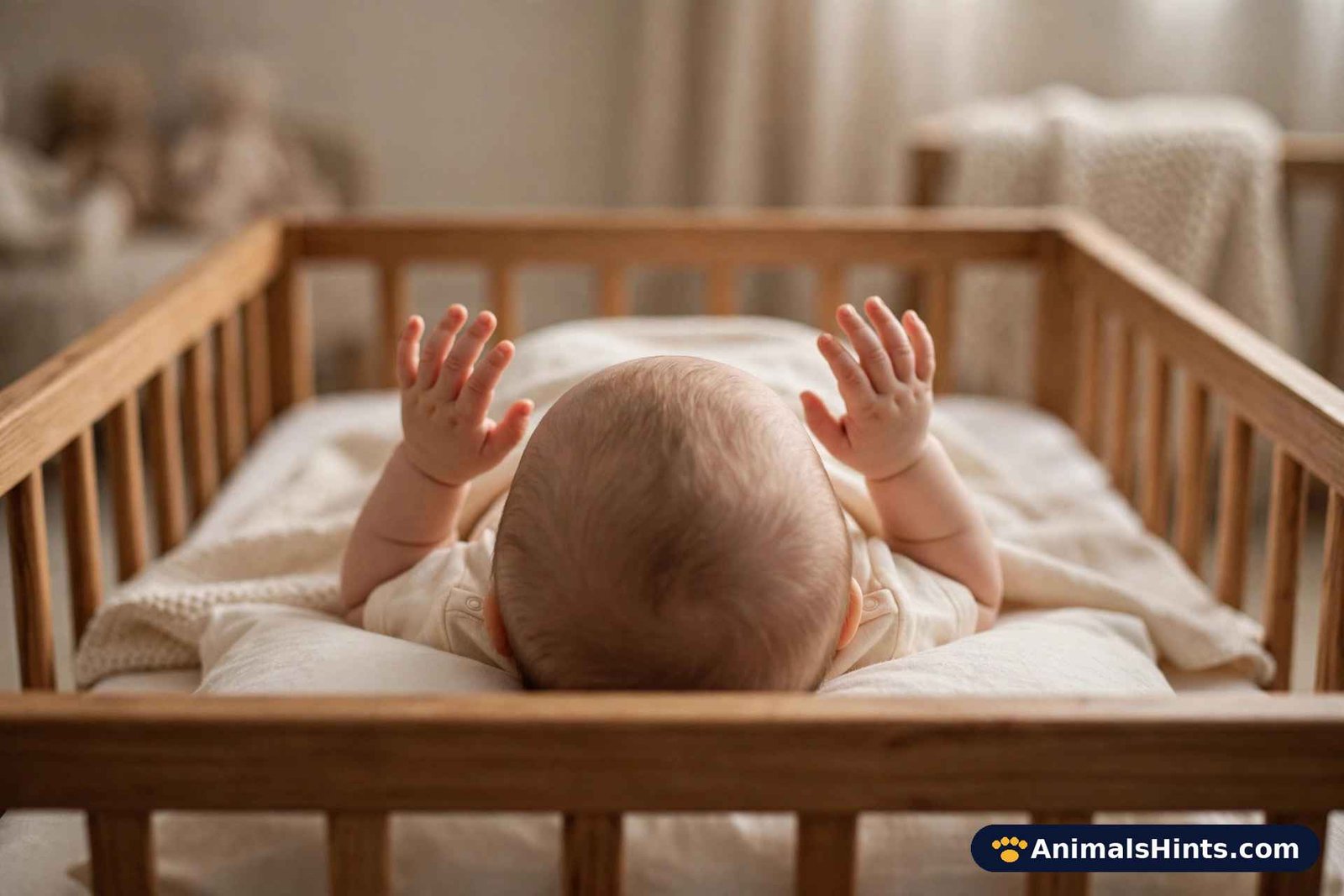
Everything above concerns adults. Babies strike this pose too, and their version has its own record, which should not be borrowed to explain grown sleepers. Many newborns rest naturally with their hands up beside the head — an arms-up style that leaves the hands near the face, where a baby can reach its own fingers and self-soothe.
Behind it sits a reflex. The Moro, or startle, reflex answers a sudden sound, a movement of the head or the sensation of being lowered: the baby’s arms fling outward and up, hands open, then draw back in toward the body. It is present from birth and fades by about six months of age. A still photograph can freeze the middle of that sequence and make a movement look like a chosen pose — one more reason the infant picture and the adult omen should be kept in separate drawers.
Lifted Hands in the Bible Are a Waking Posture
Scripture does speak of hands lifted high, and the two texts that do it most plainly deserve quoting exactly. David, in Psalm 63:4: “Thus will I bless thee while I live: I will lift up my hands in thy name.” Paul, in 1 Timothy 2:8: “I will therefore that men pray every where, lifting up holy hands, without wrath and doubting.”
Both are waking acts — blessing and prayer, performed on purpose, by people standing in their right minds. The resonance with the sleeping posture is real as imagery: the same upward shape, the same openness. But the gap must be stated just as plainly: no biblical text reads a sleeping posture as an omen, a sign or a message. The Bible’s lifted hands are lifted deliberately, and stretching them into a doctrine of sleep would be this article’s invention, not the text’s.
Final Thoughts
Taken all together, the posture supports two honest statements and a shelf of attributed ones. The body record says the shape is a habit a minority of sleepers keep, that it can cost a numb arm and a snored night, and that babies arrive at it by reflex. The tradition says considerably more — surrender, trust, attunement, release — and those readings are carried in full above, labelled as what they are.
Which leaves the sleeper where every body sign leaves its reader: with a vocabulary, not a verdict. If the twelve readings help you name a season you are in, they have done the work such lists can do. If they do not, the survey’s plainer account remains — a starfish sprawl, five percent of sleepers, arms up around the pillow, comfortable enough to stay there until morning. The arms come down at waking either way; the day, as usual, decides what any of it meant.
Frequently Asked Questions
1. What is the spiritual meaning of sleeping with arms above the head?
In the tradition’s reading: openness, surrender and trust — an undefended chest and hands raised in the direction of prayer. The survey record adds a plainer note: it is the starfish position, kept by about five percent of sleepers.
2. Does sleeping with arms above the head indicate a personality trait?
Only at survey strength. Idzikowski’s survey sketched starfish sleepers as good listeners who help readily and avoid the spotlight, but the Sleep Foundation’s summary is blunt that position-personality links have little scientific evidence behind them and have not been replicated.
3. Is sleeping with arms above the head a comfortable position?
For those who keep it, evidently — bodies rarely persist all night in a posture that hurts. Its known costs are a numb or tingling arm on waking, which usually clears in minutes, and a greater likelihood of snoring than the side positions.
4. Should I be concerned if I sleep with my arms above my head?
The posture itself, no. Concern belongs to a specific cluster instead: loud snoring with witnessed pauses in breathing, gasping awake, and heavy daytime sleepiness. Where that cluster persists, the ordinary step is a clinician’s assessment and a sleep study.