Tuxedo Cat Spiritual Meaning: Balance, Protection and the Pattern Behind the Coat
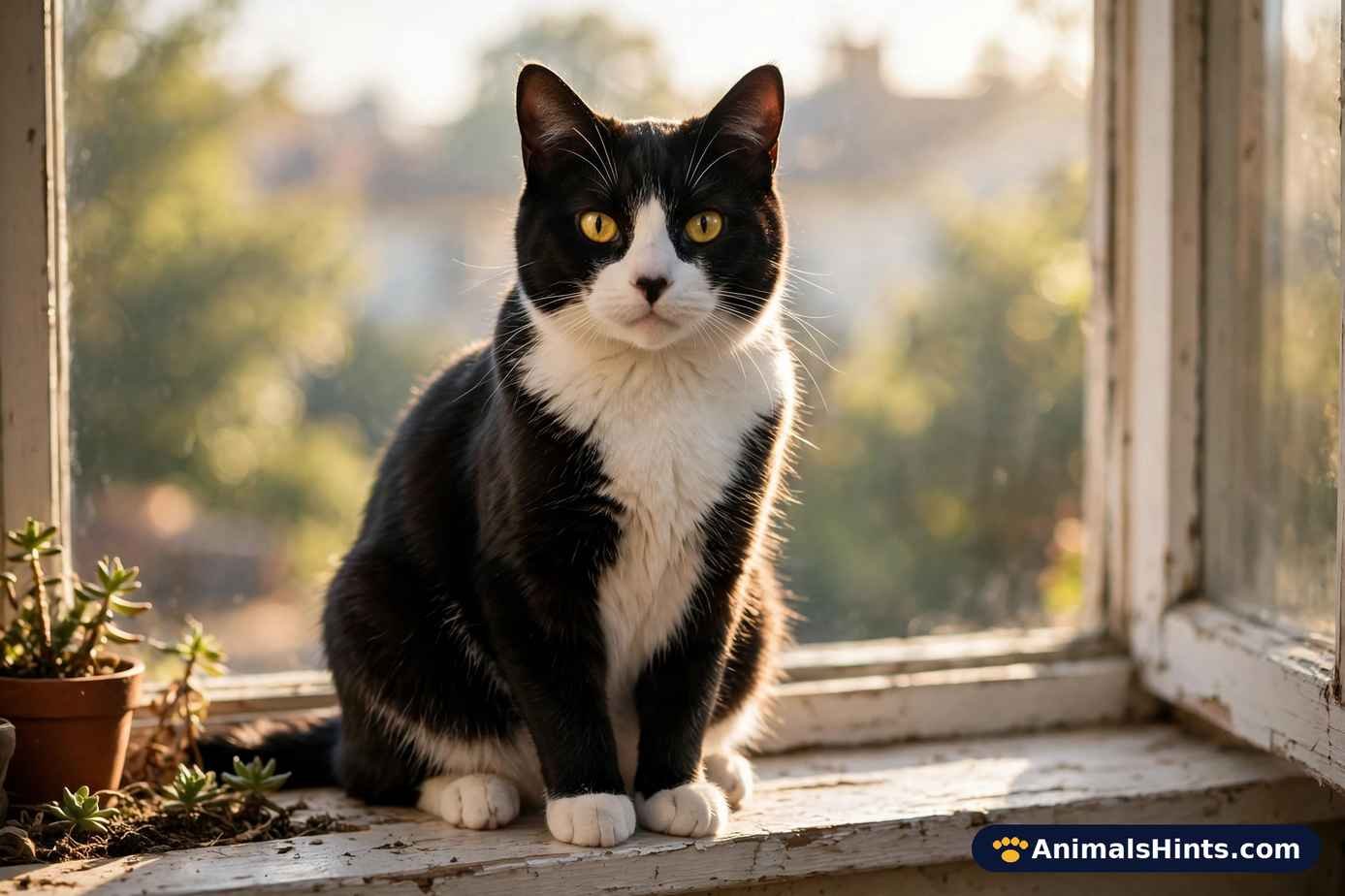
Few cats announce themselves the way this one does: black across the back, white down the chest, white on the paws, as if the animal had dressed for an occasion it never explained. The tuxedo cat spiritual meaning is the reading people build on that contrast — balance held in one body, protection worn like a uniform, and a calm suggestion that opposites can share a single life without cancelling each other out.
That reading has a second half, and this article keeps both halves in view. A tuxedo is not a breed and not a temperament. It is a coat pattern that can appear on almost any cat, produced before birth by pigment cells that never finished their journey. The lore is laid out completely below, organised around the source page’s own headings — and beside it sits the genetics record, which turns out to be just as interesting as the symbolism.
You will find the ten meanings the tradition assigns to this cat, the love and colour variations, the cultural record checked against what can actually be verified, and an honest account of where the stories end and the animal begins. What the pattern can tell you is real. What it cannot tell you matters just as much.
Not a Breed: The Coat Pattern Behind the Tuxedo
Begin with the correction that organises everything else in this article: there is no tuxedo breed. “Tuxedo” names a pattern — a mostly black coat broken by white on the chest, the belly, the paws and often the face — and that pattern can turn up on a Maine Coon, a British Shorthair, a Turkish Angora or the unregistered kitten asleep under a porch. Breed registries file the same markings under plainer labels, usually bicolour or particolour, because the pattern is a description of paintwork, not of ancestry.
The white is not a colour laid over the black. It is an absence. During development, pigment-producing cells begin near the spine of the embryo and spread outward, multiplying as they travel. In a bicolour cat, a variant in the KIT gene slows that multiplication down, so the supply of cells runs short before the far side of the body is reached. The chest, belly and paws — the districts furthest from the starting point — are the ones left unpigmented. A research team drawn from the universities of Bath, Edinburgh and Oxford published the mechanism in Nature Communications in 2016, showing that the pattern forms because the cells divide too slowly, not because they migrate too slowly as older accounts assumed.
Geneticists grade the result on a white-spotting scale that runs from one to ten. At the bottom sits a nearly solid cat with a single small locket of white; at the top, a nearly white cat carrying a smudge of colour on the head or tail. The classic tuxedo occupies the lower-middle grades: predominantly dark, with white confined to the front of the body and the feet. Two copies of the spotting variant generally produce more white than one copy, which is why a single litter can hold a near-tuxedo, a half-white cat and a solid sibling side by side.

One consequence follows, and everything after this section is written accordingly. Because the pattern is only paintwork, it arrives with no breed standard behind it, no pedigree temperament and no inherited personality of its own. Everything the lore says about tuxedo character is something people have projected onto a striking coat. The coat itself is genetics. The meaning is ours.
What Does a Tuxedo Cat Symbolize?
The symbolism starts from the one thing nobody can argue with: the contrast. A tuxedo cat carries the two most opposed tones fur can offer, arranged in a single orderly design, and traditions that read animals for meaning have treated that arrangement as a picture of balance — dark and light held together without either one winning. Where the black cat of folklore leans toward mystery on its own — the whole subject of the black cat spiritual meaning — the tuxedo is read as mystery with its counterweight attached.
From balance, the reading widens. The lore attaches perception to this cat: an animal that looks formally composed is credited with composure of mind, and its steady stare is taken as attention rather than accident. Adaptability follows, because a creature pictured as belonging to two worlds at once is easily cast as a guide between them. And protection completes the set, since black fur in the older traditions was said to absorb harm while white stood for clarity, so a cat wearing both is cast as a small guardian with the full kit.
Hold the framing honestly, though. None of this belongs to the animal itself; all of it belongs to how the pattern looks, read by people. The symbolism is real in the way all symbolism is real — as something humans made, and keep making, out of a coat that genetics made first.
10 Spiritual Meanings of Tuxedo Cat
1. Balance and Duality
The first meaning is the coat itself, read as a lesson. Black and white share this animal without blending into grey, and the tradition takes that as an image of a life that can hold contrary things — work and rest, grief and appetite, caution and nerve — without forcing them to merge. A tuxedo crossing your path gets taken as a nudge to stop treating your own opposites as a fault to be fixed.
2. Spiritual Protection
Cats were household guardians long before they were household pets, valued at first for keeping grain stores and homes clear of vermin and snakes. The lore extends that practical guardianship into a spiritual one: the tuxedo, wearing the dark that was said to soak up ill luck and the white that stood for light, is cast as a protector doubled. Read at its proper strength, the meaning says the home feels defended — and a home that feels defended is a calmer place to live, whatever you believe about the mechanism.
3. Mystical Messengers
A cat that appears at a doorway, holds your gaze and then leaves on its own schedule is easy to cast as a courier, and the tradition obliges. The tuxedo’s two-tone coat makes it a natural candidate for messages said to travel between the ordinary world and anything beyond it. The honest version of the meaning is smaller and still useful: an animal’s arrival interrupts your train of thought, and the interruption is often when a decision you were circling finally gets made.
4. Emotional Healing and Love Energy
This meaning rests on something observable. A settled cat, breathing slowly against your side, lowers the temperature of a room; people recover their composure in feline company measurably often, which is one reason cats are the animals therapists’ waiting rooms joke about needing. The lore calls that effect healing and assigns the tuxedo a special share of it. The record supports the comfort. The lore supplies the name.
5. Intuition and Psychic Amplification
The fifth meaning credits the tuxedo with sharpening the instincts of the people around it. The animal side of the claim is genuine enough: a cat hears higher frequencies than you do, sees in light you would call darkness, and reacts to movements at the edge of your perception, so living beside one can feel like living beside an early-warning system. The lore reads those sharp senses as a sign to trust your own quieter ones. As advice, it is harmless and sometimes wise; as a claim about psychic force, it is the genre speaking, and this article says so openly.
6. Transformation and Personal Growth
Cats are professionals at change: they relocate, re-rank a household and rebuild their routines around a new home with a speed people envy. The tuxedo’s dramatic coat makes it the tradition’s emblem for that capacity — the visible proof that a creature can be two things in sequence and in sum. When this cat turns up during a transition, the lore reads reassurance into it. The practical core is sound: adaptation is a skill, and this animal demonstrates it daily.
7. Twin Flame and Soul Connections
The twin-flame strand of the lore borrows the coat directly: two colours, one animal, read as two souls learning to form one life. It is the most modern meaning on this list and the one with the least history behind it — a contemporary spiritual vocabulary laid over an old pattern. It appears here because the source page carries it, weighted no heavier than that: a reading some people find meaningful about their relationships, not a doctrine with a past.
8. Wisdom and Ancient Knowledge
The knowing look is this meaning’s whole foundation, and cats earn it honestly — an animal that watches before it acts looks wise to the species that talks first. Egypt gives the meaning its scenery: cats were genuinely revered there, mummified in enormous numbers and tied to the goddess Bastet, as the culture section below sets out as far as the surviving record permits. The tuxedo inherits that general feline prestige. Nothing in the Egyptian record singles out black-and-white cats, and nothing here dresses that up.
9. Joy and Playfulness
Against all the solemn readings stands this one: the animal in formal dress is, most hours of the day, a clown — chasing nothing across a polished floor, asleep in the container least suited to its size. The lore treats that as instruction rather than contradiction. A creature can carry the symbolism of balance and still regard a cardboard box as the day’s main event, and the meaning suggests people are permitted the same arrangement.
10. Shadow Integration and Mystery
The last meaning is the first one, deepened. If balance is the coat’s surface lesson, this is its psychological form: the dark areas of the pattern stand for the parts of a person kept out of sight, and the cat’s ease in wearing them gets used as an example for acknowledging your own without being ruled by them. The vocabulary is modern therapeutic language dressed in folklore, and it appears here under that description — a frame some readers find genuinely helpful, offered by the genre rather than by any old tradition.
Does a Tuxedo Coat Make a Tuxedo Temperament?
Ask a room of tuxedo owners about their cats and a portrait assembles itself quickly: bold, clever, talkative, affectionate, slightly theatrical. The portrait is so consistent that it feels like data. It is worth asking what the research actually holds, because this is where tuxedo lore most often sets hard into a factual claim.
The largest relevant study is an owner survey run by veterinary behaviourists at the University of California, Davis, and published in the Journal of Applied Animal Welfare Science. Owners of black-and-white and grey-and-white cats did report more frequent aggression toward people in everyday interactions — but the study measured what owners reported, not what observers recorded, and the researchers’ own summary of the differences was that they were small. A separate perception study found that people assign personality words to coat colours readily and inconsistently, rating the same colours differently from one survey to the next. And the senior researcher behind the 2025 work that pinned down the orange-cat gene stated the position plainly: there is no scientific evidence yet linking coat colour to personality.
That is the honest resting point. No proven connection runs from the KIT variant that paints a tuxedo to the brain that runs the cat. Temperament in real cats is built from breed ancestry where it exists, from the first weeks of handling, and from the individual animal in front of you. The tuxedo reputation is best understood as a story owners tell about memorable cats — and striking coats make cats memorable, which is how the story keeps being confirmed.
Tuxedo Cat Spiritual Meaning in Love, Relationship, and Twin Flame
In Love and Romantic Relationships
In the love readings, the coat becomes a diagram of a workable partnership: two distinct natures, clearly bounded, sharing one life without either dissolving into the other. A tuxedo arriving during a strained patch is read as counsel toward equilibrium — say the unsaid thing, restore the exchange to balance, let difference supply depth rather than friction. As throughout this piece, the cat delivers no advice at all; the pattern is giving the advice a picture to hang on, and pictures are easier to act on than abstractions.
In Twin Flame Connections
The twin-flame reading takes the same diagram one step further into mysticism: the paired colours stand for paired souls, each carrying the other’s missing half, with the cat’s calm coexistence offered as the goal state of the bond. This article carries the reading because the tradition behind this page carries it, and names it plainly as a contemporary spiritual framework, sincerely held by the people who use it, with no historical record behind it and no claim on anyone who does not share the framework.
Symbolism of Different Colored Tuxedo Cats
Black and White Tuxedo Cat
The classic arrangement, and the only one that is strictly a tuxedo at all: a black cat wearing white at the chest, paws and face, like evening dress. The lore reads it as the full duality statement — the dark tones assigned to mystery and depth, the white to clarity and openness, the whole animal to a self that contains both. It is also the colour pairing the wider black spiritual meaning tradition works with most, which is why this variant carries the heaviest symbolism of the three.

Brown and White Tuxedo Cat
Brown-and-white bicolours exist and are handsome, though purists note the name fits them loosely, since the evening-dress joke depends on black. The lore assigns this variant the earth’s register: steadiness, warmth, the domestic virtues, a nudge toward home and physical recovery when life has run too hot. The reading follows the colour psychology of brown generally, applied to a cat; it is genre material, carried as such.
Grey and White Tuxedo Cat
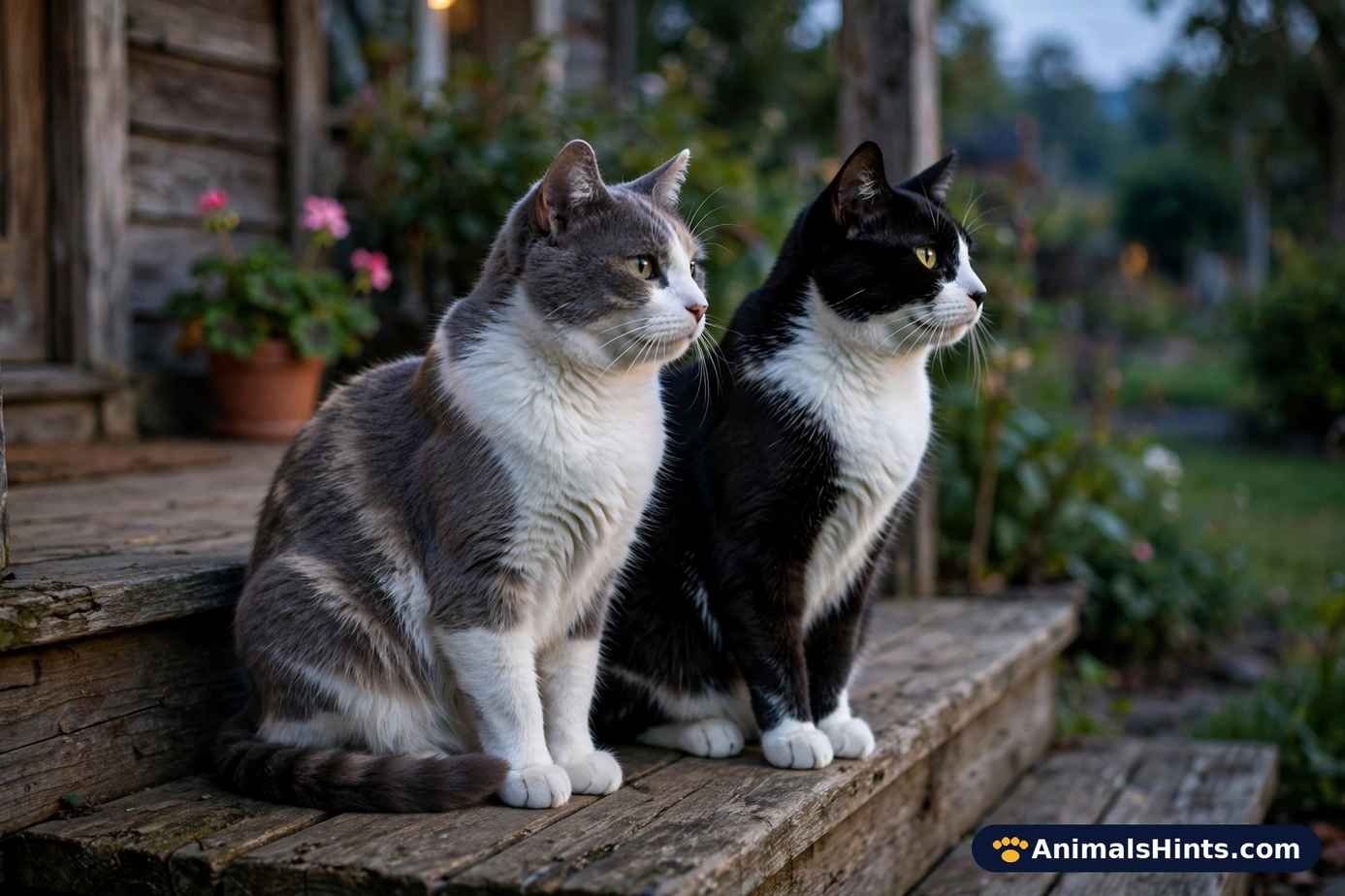
The grey-and-white cat — sometimes dressed up with the name “blue” in breed circles, though the fur is grey by any honest light — gets the quietest reading of the three: neutrality, patience, a lowering of emotional volume. The lore casts it as the household’s peacemaker and the right emblem for a season of stepping back. Genetically it is the same spotting story told over a diluted black coat, which is a tidy reminder that all three variants are one mechanism in different paint.
Cultural Significance
In Ancient Traditions
Egypt first, at the strength the record actually supports. Cats were honoured there for centuries, protected, mummified in their hundreds of thousands, and tied to Bastet, whom Britannica describes as a goddess worshipped first in lioness form and later as a cat, a daughter of the sun god whose cult centred on Bubastis in the Nile delta. That reverence belonged to cats as a kind — the art shows tabbies and solid cats, temple cats and household cats — and no Egyptian source this research could find reserves any special standing for black-and-white animals. The tuxedo’s Egyptian inheritance is real but general: it descends from a culture that took cats seriously, not from one that singled out its coat.
Japan contributes the maneki-neko — the beckoning-cat figure set in shop doorways to invite custom and luck. The figure descends from Japanese folklore about cats generally, and it is produced in many colours — white, gold, black, calico — each with its own shopkeeper’s gloss. Black-and-white versions exist on modern shelves, but the tradition does not found itself on the tuxedo pattern, and the honest sentence is that the tuxedo borrows the maneki-neko’s luck the way it borrows Bastet’s dignity: by being a cat.
In Western Superstitions
The Western record runs the other way for black cats, which collected a heavy freight of ill-omen folklore in parts of Europe — alongside an equally old counter-tradition, strong in Britain and among sailors, that treated black cats as lucky to keep. The tuxedo enters this record mostly by exemption: later folklore and modern retellings often claim the white markings softened or cancelled the black cat’s bad name. That exemption is itself folklore — a story people tell about the superstition, not a documented rule of it — and it is entered here at just that weight. Ship’s cats, at least, are solid history: cats of every colour sailed as working mousers for centuries, and a fed cat aboard was luck of the practical kind.
The Famous Tuxedos: One Documented Cat and a Shelf of Legends
Because the coat photographs like formalwear, the tuxedo has accumulated a celebrity file, and the file separates cleanly into one well-documented life and a crowd of stories that dissolve when checked. The documented life belongs to Socks, the stray tuxedo adopted by the Clinton family in Arkansas who spent 1993 to 2001 as the White House cat. The Clinton Presidential Library records the whole of it: the white paws that gave him his name, the press-room podium photograph, the children’s web page he fronted. He remains the most famous real tuxedo cat on record, and he earned it simply by being one, in public, for eight years.
Beyond Socks, the shelf thins fast. The internet’s favourite claims — that Shakespeare kept a tuxedo, that Newton and Beethoven were owned by them, that Stan Lee credited a tuxedo with inspiring a famous hero — circulate from pet site to pet site without a primary source underneath any of them, and none could be verified for this article despite being looked for. They appear in this article for exactly what they are: legends attached to a photogenic coat, enjoyable as folklore, worthless as history. Felix the Cat, at least, never pretended to be real: the silent-era cartoon star is a genuine black-and-white cultural landmark, and a drawing.
Seeing a Tuxedo Cat: Good or Bad Omen?
As a Good Omen
Most of the tradition lands here. A tuxedo encounter is generally read as favourable — balance arriving or returning, protection doubled by the paired colours, a household’s luck running with the cat rather than against it. If omens are your vocabulary, this cat speaks it kindly.
When It May Feel Like a Warning
The warning version of the reading is gentler than most animals get: the cat as mirror rather than threat, its appearance taken to mark an imbalance in the observer rather than a misfortune approaching. Even inside the lore, the tuxedo rarely carries doom. This site’s position, here as on every animal in the run, is that an omen reading is a framework people find meaningful, not a finding about the world, and a cat crossing your path is, in the verifiable record, a cat going somewhere. What you do with the pause it gives you is yours.
Living With a Tuxedo Cat: What the Pattern Does and Does Not Change
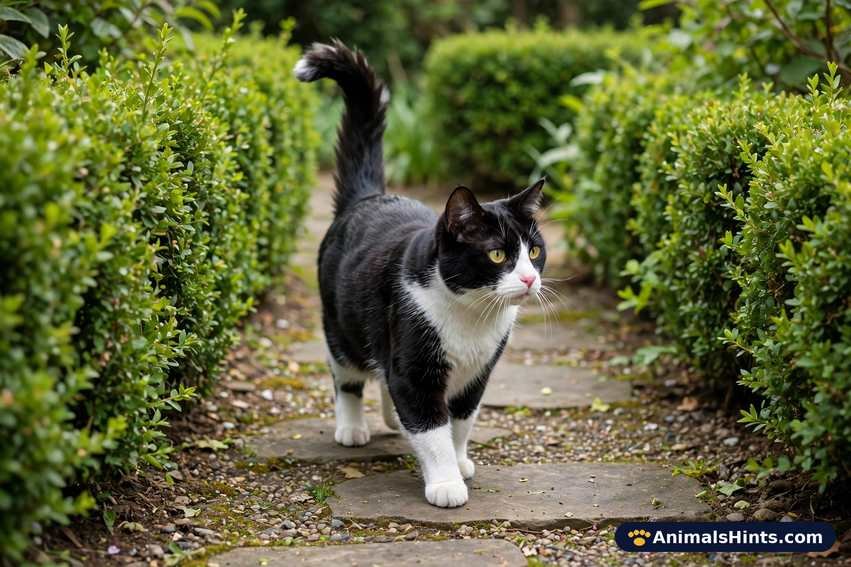
Suppose the cat has moved in. What does the famous coat actually change about the life you now share? Less than the lore suggests, and the honest list is short. The pattern changes nothing about diet, lifespan, health screening or care: a tuxedo-patterned cat needs what its breed, age and body need, no more and no less, and its white markings call for no special handling beyond the ordinary attention any pale ear or nose deserves in strong sun.
What the pattern does change is the human side of the house. People talk to a formally dressed cat differently, photograph it more, forgive it faster and remember it longer — the perception studies in the temperament section above are really about this, the way a striking coat writes the cat’s character in advance for everyone it meets. Many owners also find the cat becomes the household’s ambassador: the one visitors ask for, the one whose habits get retold. There is a quieter pleasure in the routine end of the arrangement, too — a tuxedo asleep above your head is still just a cat choosing the warmest real estate in the room, and the meaning, as ever, is the part the humans bring.
Final Thoughts
Strip the article back to its two records and they sit together comfortably. On the animal’s side of the ledger, a tuxedo cat is any cat at all wearing a pattern dealt before birth, when pigment cells spreading through an embryo ran short of numbers and left the chest and paws unpainted. On the lore’s side, the same animal is balance made visible — protection, intuition, healing and the rest of the ten meanings, read off a coat that seems to have been designed to be read.
Neither record cancels the other, and this site recommends holding them the way the cat holds its colours: side by side, clearly bounded. Enjoy the symbolism for the pause and the self-examination it prompts. Trust the genetics for everything about the animal itself. And when the stories arrive — the ancient priestesses, the composers, the film stars — ask of each one the question this article asked: where is that written down? The coat has a technical name for its pattern, piebald, and the pattern needs no legend to be remarkable. It is remarkable already, asleep on the windowsill, dressed for an occasion of its own.
Frequently Asked Questions
What does a tuxedo cat symbolize spiritually?
Balance, above all: the paired black and white is read as opposites held in one life. The lore adds protection, intuition and quiet wisdom, and casts the cat as a small guardian of the home.
What is the spiritual significance of a tuxedo cat’s coloring?
In the lore, the black stands for mystery and depth and the white for clarity and openness. Read jointly, they stand for a self — or a household — that can hold both without either cancelling the other.
Are tuxedo cats considered lucky?
In most of the tradition, yes: the encounter is generally read as a good omen, and the white markings were said in later folklore to soften the black cat’s unlucky name. That is folklore, carried as folklore.
How can I work with the energy of a tuxedo cat?
The genre’s own answer is reflective: notice where your life is out of balance, restore one exchange to equilibrium, and let the cat’s composure set the tempo. No ritual is required — attention is the practice the lore actually describes.