Crows Cawing in the Morning Meaning: 11 Spiritual Meanings, Numbers and Cultures
In the sign-reading traditions collected on pages like this one, the crows cawing in the morning meaning comes down to a message arriving with the day itself: awakening, a change already in motion, and — in several cultures — word from the ancestors. Dawn is treated as a threshold hour, and a bird famous for intelligence, memory and noise is treated as the threshold’s herald.
The bird underneath the belief deserves its due first, because morning is genuinely the crow’s busiest hour. Crows sleep together in large communal roosts through the colder months and in tight extended families all year, and both arrangements empty out at first light in a burst of calling. Much of what sounds like an omen is also, quite literally, a neighbourhood waking up — which does not settle what it means to the person listening, but it does explain why the listening happens at dawn.
This guide keeps the two accounts in their own lanes. It gives the tradition’s eleven morning meanings in full, then the superstitions, the number readings for one to five birds, and the cultural record from Hindu ancestor rites to Odin’s dawn-flying ravens. Woven between them is the verified ornithology: why crows actually vocalise at daybreak, how to tell a crow from a raven at sunrise, and an honest verdict on the good-omen question. Belief is labelled as belief throughout. Biology is labelled as biology.
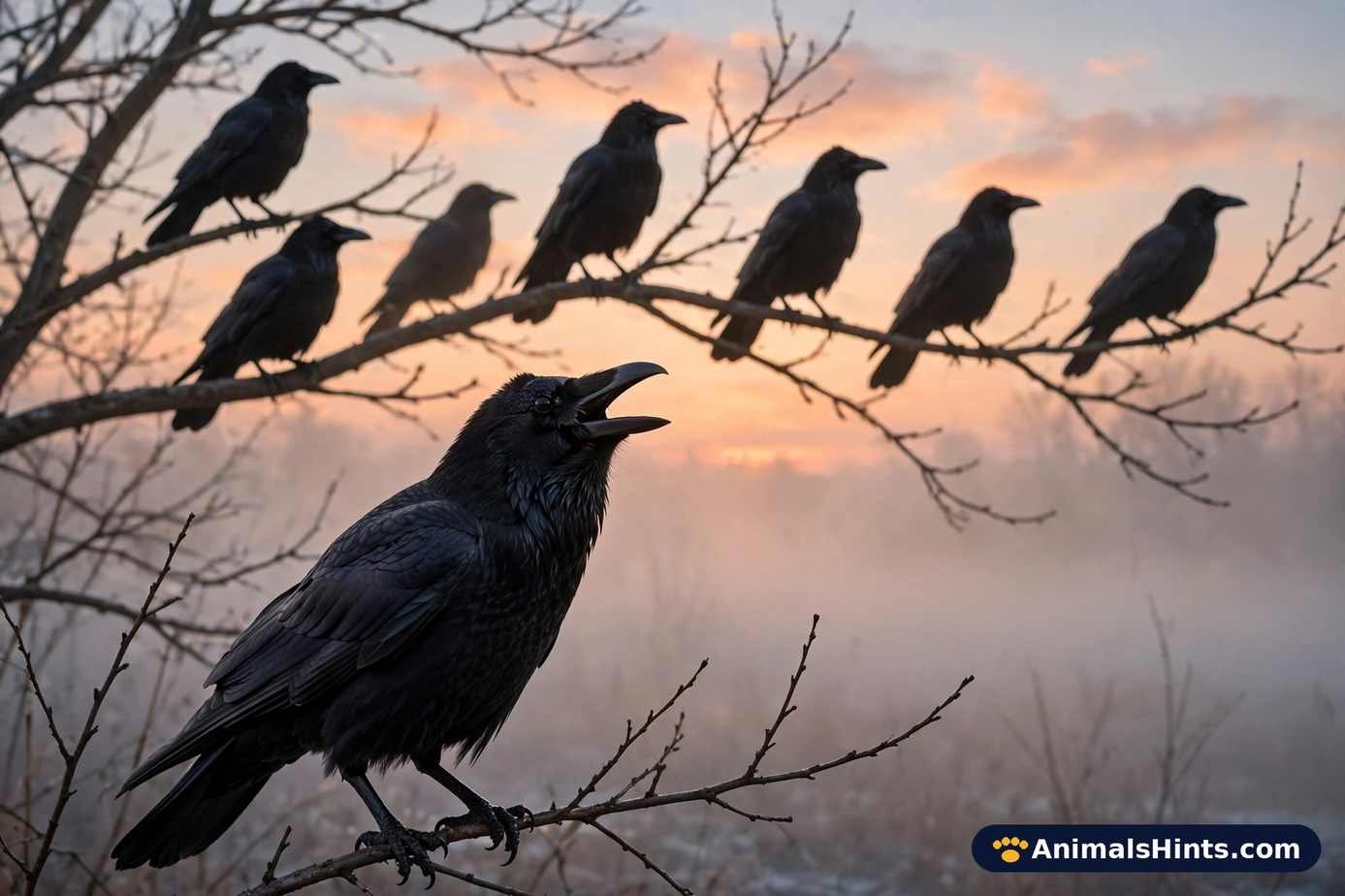
What Does a Crow Caw in the Morning Symbolize?
At the broadest level, the morning caw is read as a symbol of awakening in three registers at once. The day is beginning, so the bird is read as beginnings. The call is loud and impossible to sleep through, so it is read as awareness — a nudge to notice what you have been walking past. And because crows move easily between rooftops and treetops, ground and sky, they are read as go-betweens: creatures whose dawn announcement might be carrying something from the far side of that movement.
Duality is the second theme the tradition returns to. The crow is black-feathered and dawn-announcing, a carrion eater with a celebrated mind, a bird of graveyards that also raises devoted families. Sign readers treat that doubleness as the point rather than a contradiction: endings and starts, darkness and light, held in one animal. The colour half of that pairing has a literature of its own — our companion guide to black spiritual meaning treats it separately — while this page stays with the bird and the hour.
Intuition is the third register. Because crows demonstrably watch, remember and work things out, the tradition casts the morning caller as a prompt to trust your own perception: the first thought you had when the call cut through, the detail you noticed yesterday and dismissed. And in the Asian and African strands of the tradition, a fourth register joins the rest — ancestry. A crow calling at daybreak is received, in those tellings, as a loved presence reporting in, or as guidance sent ahead of the day by someone who walked it before you. None of these are findings. They are the symbolic grammar the rest of this article is written in, and they are offered in that spirit.
Why Crows Really Caw at Dawn: Roosts, Families and First Light
Start with the simplest fact in this whole subject: crows are daytime birds with poor night vision. The Cornell Lab of Ornithology’s crow FAQ, written by crow researcher Kevin McGowan, notes that crows do not see well after dark while owls — their most dangerous enemies — see very well indeed. A crow’s world therefore starts at first light by necessity, and its voice starts with it. The morning chorus of cawing is what a diurnal, highly vocal, highly social animal sounds like when its working day begins.
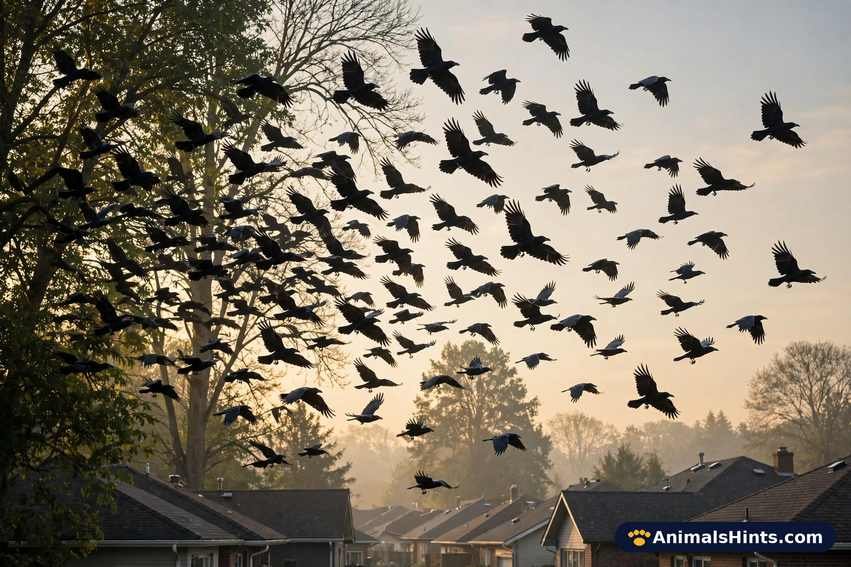
The biggest dawn performances come from the roosts. Outside the breeding season, and above all in fall and winter, American Crows gather to sleep in communal roosts that the Cornell FAQ describes as ranging from under a hundred birds to, in the most spectacular cases, more than a million; roosts of tens of thousands are common, and numbers peak in winter before thinning near the start of the breeding season, usually in March. BirdNote’s account of one long-standing Illinois roost, at Danville, puts local counts above 100,000 birds — and records that the first thousands begin leaving in the morning, about an hour before sunrise. Multiply one family’s wake-up calls by a small city’s worth of birds and the dawn racket needs no supernatural explanation at all.
Why sleep in such crowds, and why leave them noisily? Science holds its answer more loosely than folklore holds its own, and the honesty is worth copying. McGowan’s FAQ lists the roost’s purpose as still largely conjecture, with several live hypotheses: safety in numbers against those owls; a shared, favourable sleeping place; and the information-centre idea, under which a crow that fed badly yesterday can watch for roostmates that look, in his phrase, fat and happy, and follow them out first thing in the morning to wherever the food is. On that last hypothesis, dawn calling is partly coordination — a crowd organising its departures — which is as good a one-line account of morning cawing as ornithology currently offers.
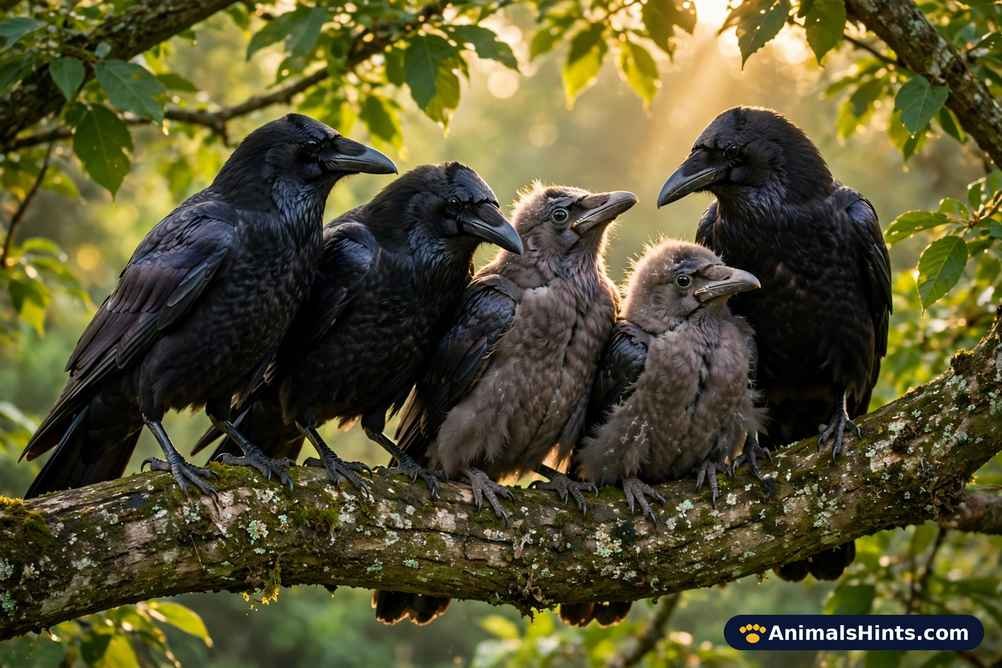
The year-round version of the same story is smaller and closer to home. American Crows are cooperative breeders — Cornell describes them as the most widespread cooperatively breeding species in North America — and they live in extended families built around a breeding pair and their offspring from earlier years. A family can reach fifteen birds; youngsters may stay for five years or more, helping to feed the incubating mother, feed nestlings, guard foragers and defend the territory. McGowan’s colleagues field the public’s dawn complaints with a standing explanation, preserved in a Cornell Lab article on neighbourhood crows: people who report being woken by noisy crows are usually hearing an extended family starting its day. The household that caws outside your window at six is most likely exactly that — a household.
The calls themselves are a working language, not a single note of alarm. Crows hold a wide repertoire — McGowan’s FAQ, asked how many different calls they make, answers “lots, but most of them still sound like ‘caw'” — and researchers have shown that an individual caw carries information about the caller’s sex and identity, which is how a family keeps track of itself by ear in half-light. The familiar caw is typically delivered in short bouts; a shortened, sharper version serves as an alarm. Set beside that repertoire, the danger end of the scale is easy to recognise when it comes: a crow that spots a roosting owl by day will recruit its relatives into a mobbing chorus around it, and the bird at the centre of that noise is the subject of our guide to spiritual meanings of seeing an owl. Ordinary dawn cawing sits at the calm end of the same system — contact, coordination and roll call, in a voice built to carry across a waking territory.
11 Spiritual Meanings of Crow Cawing in the Morning
The tradition keeps eleven readings for this encounter, and they are set out below in its own order. Read them the way their holders do — as prompts for reflection at the start of a day, not as forecasts about how the day will go.
1. New Beginnings
The first reading is the calendar’s own. A voice arriving with the first light is taken as a marker of thresholds: a fresh day, plainly, but by extension a fresh phase — a project started, a mindset changed, a door walked through that was only being considered yesterday. In this telling the crow’s darkness works in the reading’s favour: the bird associated with endings is the one announcing a start, which the tradition reads as permission to treat an ending as a beginning wearing work clothes.
The practical counsel attached to this meaning is intention-setting. Morning is when the reading is strongest, believers say, precisely because nothing has happened yet: the call is received as an invitation to decide what the day is for before the day decides for you. Letting go of yesterday’s residue — the grievance, the worry that outlived its usefulness — is the housekeeping this meaning always prescribes first.
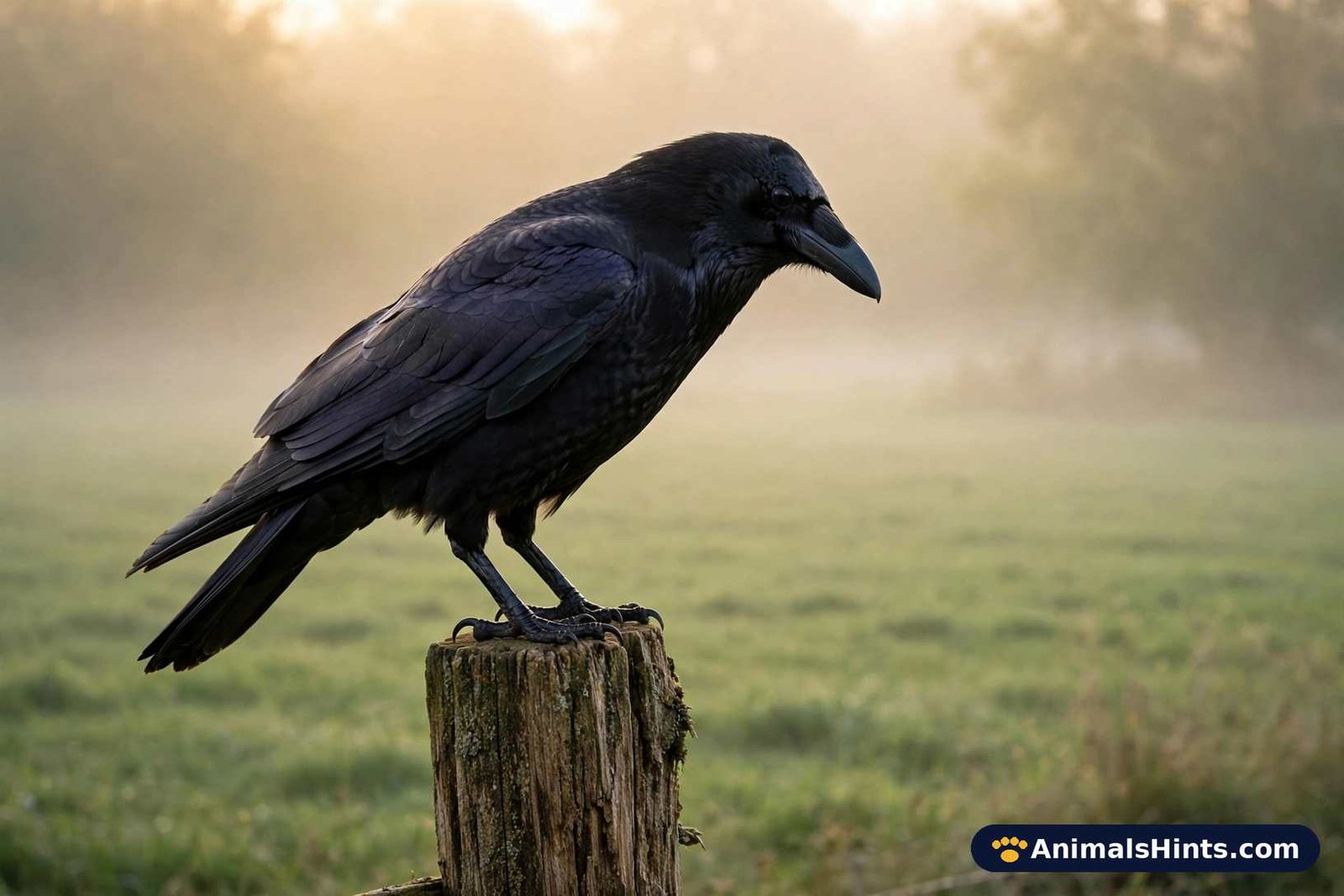
2. Awakening Inner Power
The second reading takes its cue from the sound itself. Nobody has ever described a caw as hesitant. In the tradition, that unapologetic volume at daybreak is mirrored back at the listener as a question about their own voice: where have you been quiet out of habit rather than judgment, and what would speaking at full volume — at work, at home, in your own defence — actually require?
The crow’s documented cleverness is folded into this meaning as resourcefulness: the bird solves problems with what is at hand, and the reading borrows the posture. Confidence, here, is not presented as a mood to wait for but as a practice the morning is asking you to start — trust the instincts you have, act on the knowledge already in the house, and let the call stand as the sound of a creature that does not apologise for taking up acoustic space.
3. Connection to the Spirit Realm
The third reading is the one that gives this whole subject its charge. In many tellings, birds in general and crows in particular are cast as intermediaries — at home in the sky, at home on the ground, and therefore plausible couriers between the human world and whatever lies past it. A crow calling at dawn, when the day itself is still half in night, is read as a message in transit: guidance, reassurance, or a simple registering of presence from the far side.
The tradition’s handling of this one is notably gentle. The message is rarely described as urgent or frightening; it is more often a reminder that the listener is accompanied. Believers are advised to notice what follows — a dream that stays with you, a coincidence of timing, an intuition that will not sit down — on the theory that a courier’s first knock is seldom the whole delivery.
4. Release and Surrender
The fourth reading runs against the second, deliberately: where that one says speak up, this one says let go. A morning crow is received, in this strand, by people holding something too tightly — an outcome they are trying to force, a guilt being carried past its term, a plan defended long after it stopped fitting. The call is read as a loosening: surrender the grip, not the goal.
There is a small acoustic poetry the tradition leans on here. A caw does not linger; it is made, it carries, it is gone, and the bird does not call after it to check where it landed. Release, in this reading, is modelled the same way — say the thing, set down the weight, and let the morning move without dragging yesterday behind it. What grows in the cleared space is the next meaning’s subject as often as not.
5. Good Fortune
The fifth reading is the optimist of the set. Across a range of tellings — the competitor gathers Native American and Eastern strands under this heading — a crow’s morning call is tied to luck gathering: opportunities forming, efforts approaching their payoff, a run of alignment after a run of friction. Fortune, in this tradition’s careful version, is seldom only money; it is just as often the right person arriving, the obstacle dissolving, the sense of a road clearing.
The crow’s character is again used as evidence inside the story. This is a strategist of a bird, a watcher that misses little and wastes less, and its dawn appearance is read as a green light for the listener’s own strategy: keep moving, keep the momentum warm, and let luck do what it is said to do — find the people already in motion.
6. Facing Fears
The sixth reading addresses the listener who heard the call and flinched. Crows carry a frightening reputation they did little to earn, and the tradition turns that reputation into curriculum: a fear faced at the very start of the day, in miniature, as rehearsal for the larger one being avoided — the conversation, the decision, the truth filed under later.
The teaching attached is measured rather than theatrical. Courage in this reading is not the absence of fear and not a charge at it; it is forward motion with the fear admitted and informed. The crow is the mascot because it is nobody’s idea of a timid animal: it announces itself, holds its ground, and gets on with the day. The morning call, read this way, is life asking whether today is the day the avoided thing gets faced.
7. Guidance and Awareness
The seventh reading treats the call as an attention device. Something in the listener’s situation — a pattern repeating, a detail overlooked, a sign previously filed under coincidence — is, in this telling, asking to be looked at properly, and the crow has volunteered as the highlighter. The bird’s own habits underwrite the metaphor: few common birds watch their surroundings as continuously or as intelligently as a crow does.
Guidance, in this strand, seldom arrives as instructions. It arrives as noticing: the sudden clarity about a situation you have been describing wrongly, the realisation that lands while you are still standing at the window. The prescribed response is a pause rather than a leap — be still for a moment, listen with more than your ears, and let the day show you which of its details the call was pointing at.
8. Transformation and Change
The eighth reading is the set’s deep one. Crows stand, in the symbolism, at the seam between states — night and day at the hour this article is about; life and death in their older carrion associations; ignorance and knowledge in their trickster-teacher tales. A call from that seam at dawn is read as notice that the listener is mid-crossing themselves: an old version of a life being shed, a belief outgrown, a habit in the act of loosening.
Alchemy is the comparison the tradition reaches for — base material worked, slowly and not always prettily, into something finer — and the reading is honest about the process being uncomfortable. The reassurance built into it is directional rather than immediate: unsettled, in this framing, is what being refined feels like from inside, and the morning voice is there to say the crossing is under way rather than stalled.
9. Reflection on Relationships
The ninth reading turns the lens on the listener’s people. A crow calling near the home in the early hours is read as an invitation to audit the bonds: who gets your energy, which connections run balanced and which run one-way, where a silence has been doing the work a conversation should. The bird is a pointed choice of messenger for this one, because few animals are as thoroughly relationship-built as a crow — mated long-term, family-raising, grievance-remembering.
Check in, the reading advises — with yourself first, and then with the people the audit surfaced. Unresolved emotion is the specific target named most often: the morning call as a reminder that a bond repaired early in the day, or early in a difficulty, costs less than the same repair left to harden.
10. Reminder of Ancestors and Guardians
The tenth reading is the tenth meaning’s close cousin to the third, and the distinction matters to its holders. Where the spirit-realm reading is about messages in general, this one is about particular people: the dead who were yours. A crow at dawn is received as a greeting from them — protection restated, encouragement sent, the connection across the separation reaffirmed at the day’s most threshold-like hour.
Believers describe the confirmation as atmospheric rather than verbal: a song that was theirs, a thought that arrives wearing their voice, a scent crossing a room it has no route into — the wider family of such signs is catalogued in our guide to spiritual smells and their meanings. The comfort is the content, in this reading. The crow is simply the one who knocked.
11. Embracing Mystery and Wisdom
The eleventh and last reading is the set’s capstone, and it is an instruction to stop trying to finish the puzzle. Crows are genuinely hard to fully account for — tool users, face rememberers, players, mourners of their own dead in gatherings science still describes cautiously — and the tradition takes the bird’s unresolved intelligence as a teaching: some things are to be lived alongside rather than solved.
Wisdom, in this strand, grows from experience and observation rather than from immediate answers, and the morning call is read as an enrolment reminder. Stay curious. Keep watching. Let a few of the day’s questions stay open past breakfast. The bird that knows the most about your street, the tradition notes, is also the one still asking it questions.
Superstitions Associated with Crow Caws
Superstition is the older, rougher layer under the polished meanings above, and the morning call has collected plenty of it. The best-documented strand is also the warmest. In Indian folk belief — recorded, among other places, in the USC Digital Folklore Archives from Indian and Pakistani families alike — a crow cawing at the house is the classic announcement that a guest is coming: the bird at the window in the morning, and visitors by afternoon. Grandparents delivered the reading as household fact, and in many homes it is still repeated with a smile that is only half ironic.
The Western strand historically ran colder. A lone crow calling at sunrise was liable to be filed as a warning — of change, of trouble, of something to be watched for — in a Europe that associated the bird with battlefields and gallows. The modern spiritual retelling of that strand keeps the structure and reverses the charge: not doom, but attention. The old warning is read today as a prompt to examine whatever you have been ignoring, on the theory that the crow was never the threat; it was the notice.
The Japanese and Celtic strands each get a fuller hearing in the cultural section below, but their superstition-level forms belong here: in Japan, the crow’s morning voice sits inside a tradition that honours a crow as a heaven-sent guide, and a dawn call is received as blessing and protection rather than omen; in the Celtic telling, a crow at daybreak carries the Morrígán’s weather — prophecy, fate, and the sense that clarity about a hard matter may be on its way. Hold all of it as what it is: inherited belief, varying by household and century, and never — in any strand — a substitute for what the day itself tells you.
Meanings of Number of Crows Cawing: 1, 2, 3, 4 and 5
The number tradition counts birds, not calls — a distinction worth making at the top, because the two habits are often tangled. The readings below attach to how many crows are present and calling together. A separate, looser modern habit counts individual caws instead; it is a borrowing from this bird-count system rather than a system of its own, and ornithology adds a dry footnote — a crow’s ordinary caw is delivered in short bouts of a few calls at a time, so a run of three caws usually means one bird saying its ordinary sentence. Count the birds for the traditional readings. The middle case below gets a page of its own on this site: our guide to seeing 3 crows spiritual meaning.
One more piece of housekeeping belongs here, because the tradition’s language needs it. A gathering of crows carries the famous collective name “a murder” — a poetic coinage, as Cornell’s crow FAQ puts it, that no scientist uses; scientists say a flock. The readings that follow belong to the poetic register, and they are none the worse for it, so long as nobody mistakes the register for a report.
1 Crow Cawing
One crow, in the tradition, is the personal case: a message addressed to a single listener, undiluted by company. It is read as a prompt toward introspection and individual change — listen inward, weigh the decision in front of you, and treat the call as a nudge to trust your own reading of your situation. A cautionary thread runs inside this one in some tellings, advising care around an important choice. Solitude is its keynote either way: one bird, one listener, no crowd to hide in.
2 Crows Cawing
Two crows are read as the partnership number: balance, pairing, cooperation. The tradition takes the doubled call as an encouraging sign — good news travelling, help or understanding approaching, a joint effort about to pay. Underneath the omen sits the tradition’s favourite piece of arithmetic: paired forces that need each other — effort and rest, logic and intuition — and the reminder that the day’s work may go better shared than solo.
3 Crows Cawing
Three is the number the tradition loads most heavily. Threes carry sacred weight across many faiths, and three crows together are read as alignment: events quietly arranging themselves toward your purpose, guidance confirmed rather than merely offered. In the folklore strand, three crows are tied to prophecy and protection — birds posted, as it were, at the corners of a transition, reassuring the listener that the crossing is accompanied. Uncertainty, in this reading, is precisely when the three are sent.
4 Crows Cawing
Four crows are read as the structure number: stability, foundations, the material world holding its shape. A morning quartet is taken as a sign that a stretch of confusion is settling into order — the plan firming up, the household steadying, the ground going solid again under a project. Some tellings salt the reading with endurance: a test of patience may be part of the arrangement, and the steadiness is the reward as much as the result. Stay grounded is the whole counsel.
5 Crows Cawing
Five crows are read as the change number at full volume: movement, adventure, renewal. A dawn chorus of five is taken as notice that a transformation is close — an opportunity, a shift of mindset, a door where a wall was assumed to be. The tradition concedes the energy can feel unsettling; five is the number of breaking a standstill, and standstills rarely break quietly. If you have been feeling stuck, this is the configuration the tradition addresses you by name with: leap, carefully, but leap.
Crow or Raven at Sunrise? Telling the Dawn Caller Apart
Before any of the readings above are applied, a prior question deserves an honest answer: was it a crow? The crow’s larger cousin shares its colour, its family and much of its folklore, and morning half-light is exactly the condition under which the two get confused. The distinction matters to the biology, and — as the Norse section below shows — the myths themselves kept the two birds on different assignments.
Size is the first test. An American Crow runs about 40 to 53 centimetres long with a wingspan of roughly 85 to 100 centimetres; a common raven is a substantially bigger bird, around 56 to 69 centimetres with a wingspan well past a metre. Shape helps at a distance: the crow’s tail fans out rounded in flight, the raven’s comes to a central point, flying as a wedge or diamond. The bill follows the same ratio — the crow’s is sturdy, the raven’s is a heavy chisel — and the flight styles differ, the crow rowing steadily along where the raven intersperses glides and is not above aerobatics.
Voice settles what silhouette leaves open, and dawn is a voice-first encounter anyway. The crow gives the familiar hoarse caw, typically in those short bouts described earlier. The raven’s standard call is a deep, resonant croak — a sound with the bottom end left in — alongside a repertoire of knocks, gurgles and bell-like notes no crow attempts. If the sunrise caller croaked from somewhere deep in its chest, the tradition you want is the raven’s, and this article’s meanings — written for crows, in the crow’s own dawn register — should be read with that substitution honestly in mind.
Cultural and Religious Significance
Every culture that has lived alongside crows — which is most of them — has filed the bird somewhere in its account of the world, and the morning call inherits all of those filings at once. Five strands make up the standard survey, set out here in the tradition’s usual order.
In Hinduism
The Hindu strand is the most ritually concrete of the five, because it comes with a practice attached. In the ancestor rites of Shraddha, and above all during Pitru Paksha, the fortnight given to the departed, food is set out for crows as part of the offering: the bird is treated as a messenger of the ancestors, its acceptance of the food is received as a sign the offering has reached them, and in many households the family eats only after the crow has. Against that background, a crow calling near the home in the morning is read as a visit in the same register — ancestral presence, a blessing delivered, or a reminder of a duty to the dead left unfinished. It is, notably, not read as a bad omen: the crow at dawn is family business, not a threat.
In Christianity
The Christian strand rests on provision. The Bible’s great speech from the whirlwind in the Book of Job reaches the crow’s family as its closing example of divine care: “Who provideth for the raven his food? when his young ones cry unto God, they wander for lack of meat” (Job 38:41, KJV). Two honest precisions belong with the verse. The bird it names is the raven, not the crow — a close cousin in the same genus, and the text makes no finer distinction than its own. And no biblical passage reads a morning caw, or any bird call, as an omen to be decoded; the verse’s point runs the other way, toward a God who feeds creatures that cannot ask. Christian devotional reading of a dawn crow builds on that ground — watchfulness, trust in provision and timing — and it is at its most defensible when it stays there.
In Native American Traditions
The Native American strand is the one this survey holds most carefully, because there is no single version of it: the crow traditions of hundreds of distinct nations do not compress into one doctrine, and any summary — including the competitor’s — is a modern digest of themes rather than a teaching any one people would state in exactly these words. In that digest, the crow figures as wise, tricky and transformative by turns: a teacher and protector in some tellings, a shape-changer and culture-bringer in others, a bird whose intelligence is the whole point of its stories. A dawn call, in that framing, is received as a reminder to put wisdom before action — the bird that sees most, speaking first — and as a sign of guidance toward balance between the physical and spiritual sides of a life. Hold it at exactly that strength: a general frame, honestly labelled, over a record far richer than any summary.
In Celtic and Norse Beliefs
The Celtic strand is dominated by one figure. The Morrígán of Irish myth — associated above all with war and fate, with foretelling doom, death or victory — often appears as a crow, the badb, over the battlefield, and her crow-form is the lens through which a dawn crow is still read in the Celtic telling: prophecy weather, a hard matter approaching its decision, foresight offered at a price. The Norse strand keeps a different pair of birds on a strikingly relevant schedule. Odin’s ravens Huginn and Muninn — their names usually rendered Thought and Memory — sit on his shoulders and are sent out at dawn, in the Prose Edda’s account, to fly over the whole world and return with everything they have seen and heard whispered into his ear. Ravens again, note, not crows; the northern myths assigned the dawn reconnaissance to the bigger bird. But the pattern the strand contributes to this article is unmistakable: at daybreak, a black bird goes out, and knowledge comes back.
In Eastern Beliefs
The Eastern strand is the most reverent of the five. In Japan, the crow of the founding myths is Yatagarasu, the great crow remembered in the early chronicles, the Kojiki and the Nihon Shoki, as a heaven-sent guide who led the legendary first emperor, Jimmu, through the mountains to Yamato; in the Nihon Shoki telling, the sender is Amaterasu, the sun goddess herself. One correction the record itself supplies: the chronicles describe a great crow and say nothing about legs — the famous third leg arrived later, borrowed from the three-legged crow that Chinese lore placed inside the sun. A morning crow in Japan is received inside that inheritance — guidance, divine order, a blessing with good posture — and in the Chinese strand the bird carries the sun association with it: clarity, discipline and purpose at the hour the sun returns. Fear is not the register in either telling.
Is Morning Crow Cawing a Good Omen or a Bad One?
The traditions do not agree, and this guide will not pretend they do. On the good side of the ledger stand the Hindu ancestor reading, the Indian guest at the door, the Japanese blessing, the genre’s good-fortune meaning and the number system’s encouraging pairs and threes. On the warning side stand the older Western lone-crow reading, the Morrígán’s prophecy weather, the caution threaded through the single-crow number reading, and the competitor’s own honest summary that several strands in the survey warn that a dawn crow can signal deception brewing or a conflict on its way, while others hear a spirit guide arriving.
Weighed as a whole, the record tilts toward message rather than menace. Even the warning strands, read closely, warn about attention rather than outcome: look at the thing you are ignoring, check the relationship, prepare for the change. No strand in the survey instructs the listener to expect disaster, and several of the most documented ones — the ancestor rite, the guest belief — are warm to the point of hospitality. The verdict this guide prints is the one the evidence supports: in the tradition’s own terms, a crow cawing in the morning is read far more often as a call to awareness, carrying news, than as a sentence of bad luck. And in biology’s terms, it is a family starting its day at the only hour it can — which may be the most useful reading of all, since it returns the sound to the living bird it came from.
How to Respond When Crows Caw in the Morning
The tradition’s advice and the naturalist’s advice turn out to rhyme, and the combined version is short enough to keep.
- Give it a minute. The genre’s first instruction is simply to be present: stop, listen properly, and register the thought that was in your head as the call arrived. Whatever register you file the experience in, that pause is where its use is.
- Note the particulars. How many birds, where, how long, what the light was doing. The number tradition runs on the count; the science runs on the same observations; and a note made once is a pattern recognisable the second time.
- Watch the departure if you can. A roost emptying at dawn — birds streaming out in loose lines toward their feeding grounds — is one of the commonest great spectacles in North American bird life, and it is free. Binoculars optional; the crows provide the commentary.
- Keep a respectful distance. Roosts and nests are working sites. Do not approach a nest, do not try to handle or keep a crow — wild crows are protected under the Migratory Bird Treaty Act, and keeping one is illegal as well as unkind — and let a mobbing chorus move you along if you have wandered too close to a nest in spring. The birds’ alarm register is unmistakable once you have heard the calm one.
- If you feed, feed lightly and consistently, or not at all. Cornell’s crow watchers note that a family offered occasional food scraps near a feeder may take to spending part of its day where you can see it. That is a relationship, entered knowingly — the birds will remember your face, in both senses the research supports — and it deserves the small commitment it asks.
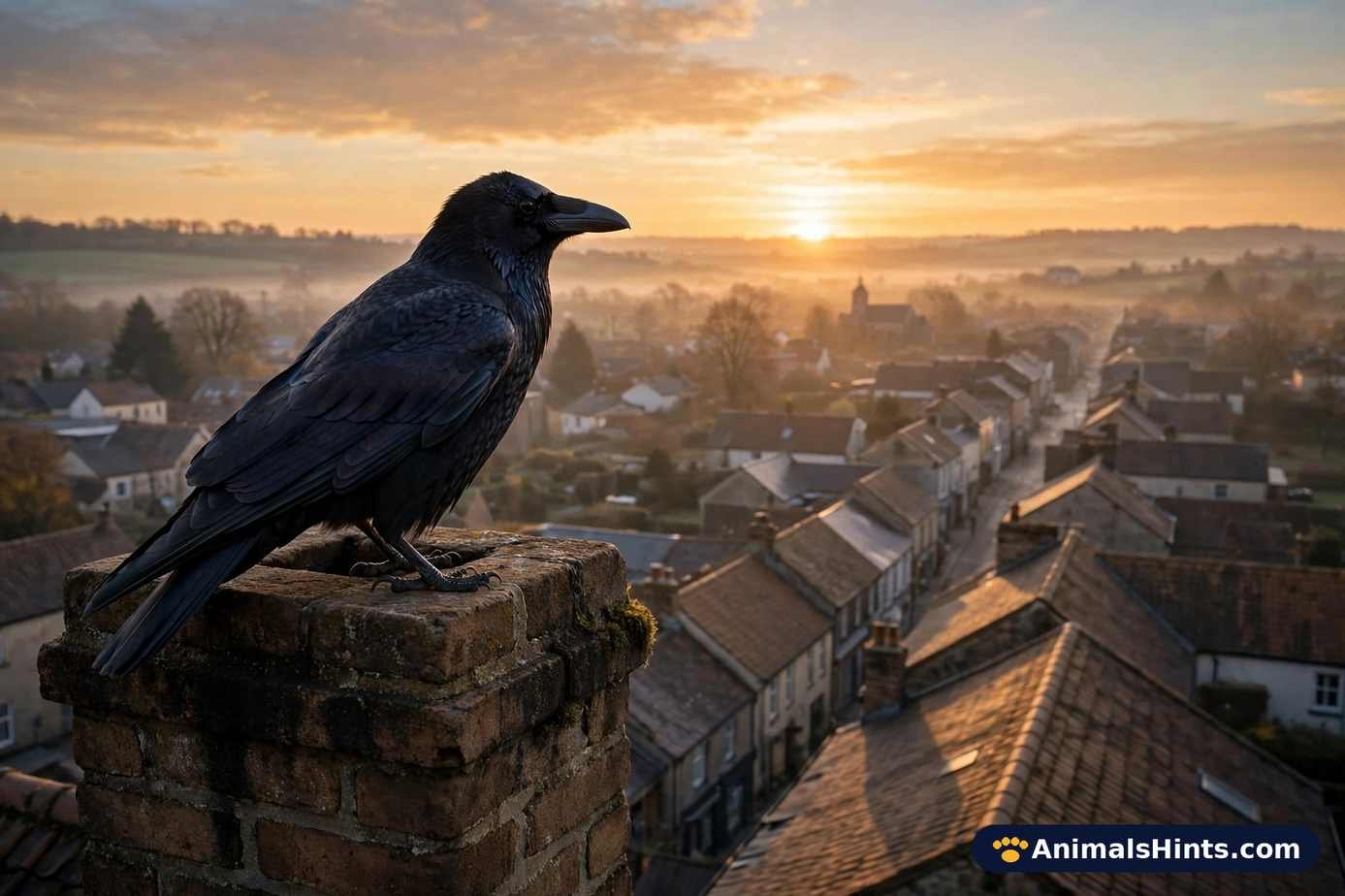
Take the meaning or leave it; the minute of attention is worth having either way. Few sounds announce that the world is back in session as reliably as this one.
Final Thoughts
A crow cawing in the morning is, on the evidence, two things at once, and this guide has tried to keep both in focus. It is a working sound from a working bird: a diurnal, family-bound, roost-sleeping animal organising its day at first light, in a voice evolved to carry across a territory and refined enough to name its owner. And it is one of the oldest prompts human beings have used to take stock at daybreak — of ancestors, of changes under way, of the thoughts that arrive before the defences are up. The traditions that read it as a message were listening to a genuinely remarkable bird; that much, at least, the folklore and the field guide agree on completely.
If the call finds you tomorrow, the assembled wisdom of both literatures amounts to this: pause, count, notice what it stirred, and then go and live the day it announced. The bird will be back the next morning regardless — crows are nothing if not regular — and so, probably, will the question of what it meant. That is no failure of interpretation. It is the arrangement working as intended, for the crow, for its cousins as far up the family tree as the common raven, and for every listener standing at a window with the light coming up, deciding what kind of attention the new day is asking for.
FAQs
What does it mean when a crow caws in the morning spiritually?
Spiritually, the tradition reads it as a message arriving at a threshold hour: awakening, transformation under way, and a prompt to awareness. Some strands add ancestral presence or guidance. The specific shade depends on the tradition and on the listener’s situation — the meanings section above gives the full set of eleven.
Is a crow cawing in the morning a sign of good or bad luck?
Both readings exist, and the documented ones lean warm: guests and ancestors in the Indian and Hindu strands, blessing in the Japanese, good fortune in the genre’s own list. The warning strands mostly warn about attention — something ignored that needs facing — rather than predicting harm. The tradition’s centre of gravity is message, not menace.
What does the number of caws mean?
Strictly, the old number tradition counts crows, not caws: one bird for a personal message, two for partnership, three for alignment and protection, four for stability, five for change. Counting caws is a newer habit borrowed from it — and a crow’s ordinary call comes in short bouts anyway, so a run of caws usually means one bird talking, not several omens queuing.
How should I respond to a crow cawing in the morning?
Pause and listen, note how many birds and what you were thinking, and let it set a minute of attention at the day’s start. Practically: watch from a distance, never approach a nest, and remember the callers are most likely a family or a roost starting their working day — which the tradition and the ornithology agree is worth a moment’s respect.