Blood Moon Meaning: The Spiritual Symbolism of the Red Moon
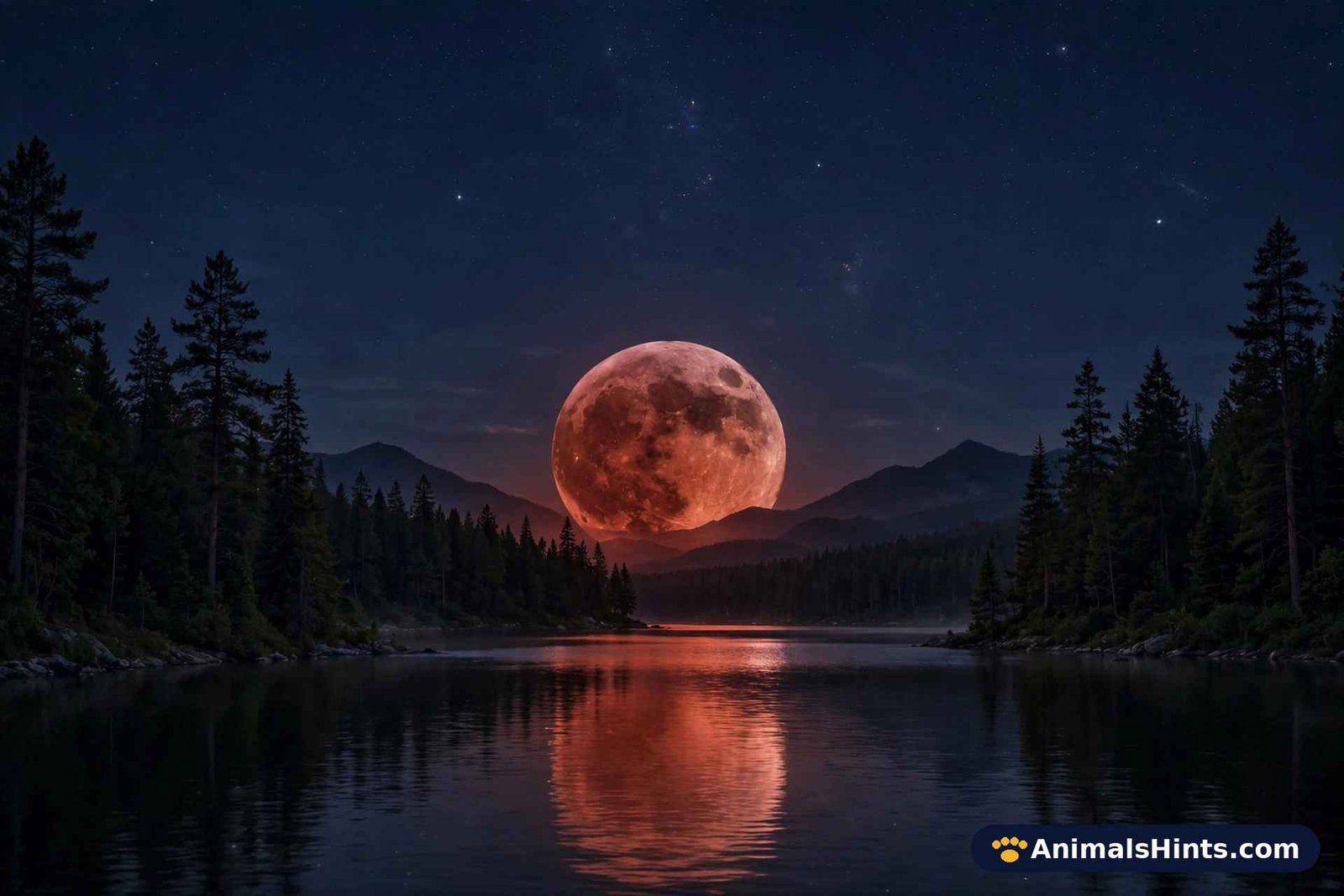
Stand outside on the right night and the full Moon does something no other regular sky event quite matches: it dims, darkens edge by edge, and then glows the colour of old copper for an hour or more. That spectacle is what the blood moon meaning is built on — a total lunar eclipse, and the layers of symbolism that people have stacked onto that red light for thousands of years.
The event itself is plain astronomy. Earth passes exactly between the Sun and the Moon, the Moon crosses our planet’s shadow, and the only sunlight still reaching it has been filtered through Earth’s atmosphere, which is why it arrives red. The meanings belong to a different register: they are what cultures, scriptures and modern spiritual writers have made of the sight, and this article keeps the two registers separate from the first section to the last.
So the pages below begin with the sky itself, then work through the symbolism, the classic spiritual meanings, the astrology, the cultural and biblical record, one famous modern prophecy, the myths, and the question everyone eventually asks — is it a good omen or a bad one? It closes with the verified date of the next blood moon, because unlike most omens, this one can be put in a diary.
First, the Sky Itself: What a Blood Moon Actually Is
A blood moon is a total lunar eclipse, and a lunar eclipse can only happen at full moon, on the one night each month when the Sun, Earth and Moon can stand in a straight line with Earth in the middle. As the Moon travels into the shadow our planet casts behind it, the bright face darkens. Earth’s shadow has two parts: a wide outer penumbra, where the dimming is so slight that many watchers miss it, and a narrow inner cone called the umbra, where the Sun is fully blocked. A partial eclipse parks part of the Moon in the umbra. A total eclipse — the blood moon — puts the whole Moon inside it.
If the three bodies line up every month, why is a blood moon not a monthly event? Because the Moon’s orbit is tilted by about five degrees against Earth’s orbit around the Sun, so on most full moons our satellite passes just above or just below the shadow and stays silver. The line-up only works when a full moon falls near one of the two crossing points of the orbits, and those chances come in eclipse seasons that return roughly every six months. NASA counts two to four lunar eclipses of some kind somewhere on Earth each year; only the total ones turn the Moon red.
The red itself is the part everyone asks about, and the answer is the sky you already know. With Earth blocking the direct sunlight, the only light that can still reach the Moon is light that has grazed through our atmosphere and been bent into the shadow. Air scatters short blue wavelengths away far more strongly than long red ones — the effect physicists call Rayleigh scattering, and the reason the daytime sky is blue and sunsets run orange. What survives the journey is the red end of the spectrum. NASA puts it memorably: during totality it is as if all of the world’s sunrises and sunsets are projected onto the Moon at once. The exact shade is never guaranteed. A clean atmosphere gives a bright copper or orange-red Moon; dust and cloud deepen it towards rust and brick, and heavy volcanic particles in the air can darken an eclipse dramatically.
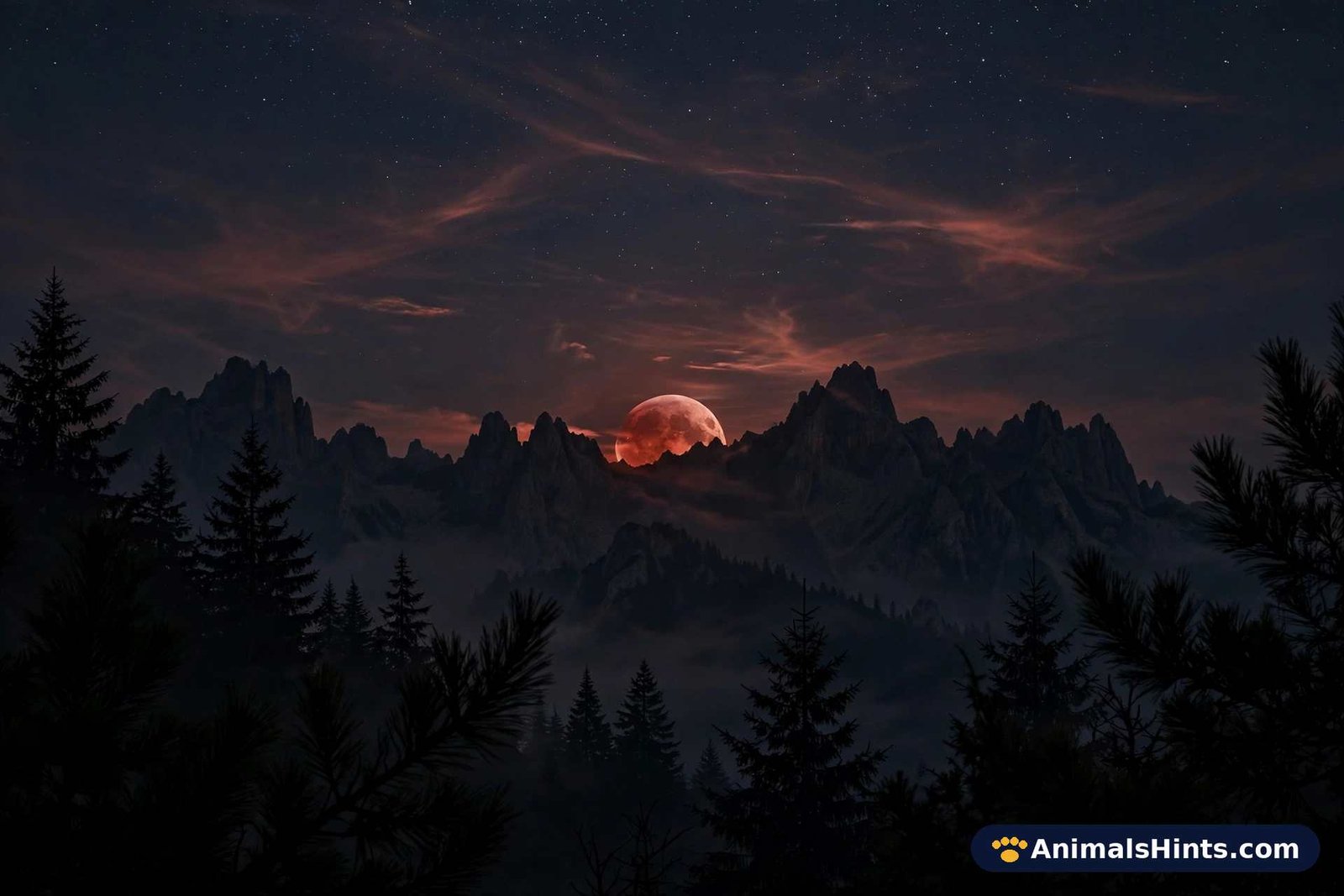
Two honest footnotes belong in any account of the event. The first is that nothing whatsoever happens to the Moon. Its surface is untouched and unharmed; the same familiar disc is sitting there in the dark. What changes is only the light reaching it, and therefore the light reaching your eyes. The second is that totality has a length, and it varies. Depending on how centrally the Moon crosses the shadow, the fully red phase can run from a few minutes to close to an hour and three quarters. The longest total lunar eclipse of this century fell on 27 July 2018 and held totality for one hour and forty-three minutes, helped by a Moon near its farthest and slowest point from Earth crossing close to the shadow’s centre.
What Does a Blood Moon Symbolize
Modern symbolism summaries — the ones repeated across spiritual writing today — gather the blood moon’s symbolism into a small, consistent cluster. It symbolises change above all: an ending that visibly clears the way for a beginning, played out in the sky in a single night. It symbolises intensity, the sense of a full moon’s already heightened emotional weather turned up further by darkness and colour. It symbolises revelation, hidden things dragged into the light — or, in the eclipse’s own image, truths that only become visible when the usual light is taken away. And it is often tied to the feminine and to cycles, because the Moon has carried those associations in most cultures for far longer than the phrase blood moon has existed.
The colour does much of the heavy lifting. The red spiritual meaning — blood, life-force, sacrifice, urgency, alarm — is the palette this event paints with, and nearly every reading in the next section is a variation on it. It is worth saying plainly, though, that this tidy symbolism is a modern synthesis. Ancient cultures had eclipse meanings of their own, and they were usually stories and warnings rather than abstract symbolism; those are in the cultural section below, and they do not always agree with the modern list or with each other.
10 Spiritual Meaning of Blood Moon (Red Moon)
One piece of housekeeping before the list: the heading above says ten, and nine meanings actually follow. That is the list as it stands in the source this article works from, kept complete rather than padded with an invented tenth. Each meaning below is stated as what it is — a reading that modern spiritual writers give the event, not a property astronomers measure in it.
Transformation and Rebirth
This is the reading almost every list leads with. In the space of a few hours the Moon appears to die — swallowed by darkness at the very moment it should be brightest — and then returns, whole and silver, before the night is out. Writers read that arc as the shape of personal transformation: a phase of life ending in shadow, and a renewed self emerging on the other side. The rebirth half of the reading leans on the return journey; the Moon does not stay red, and the point of the image is that neither does the person watching it.
Emotional Release
Full moons already carry a reputation, in modern spiritual practice, for bringing feelings to the surface. The eclipse version of that belief turns the volume up: the darkness is read as permission to stop holding things in. Practices attached to this meaning are usually private and simple — naming what has built up, crying if it comes, writing the unsent letter. Nothing in the sky requires any of it, but as a piece of emotional housekeeping the reading has an obvious logic: an event about light being covered and uncovered makes a natural mirror for feelings that have been covered up too.
Spiritual Awakening
For some writers the blood moon is a threshold moment — a night when the veil between the ordinary and the spiritual is at its thinnest, and when realisations arrive that ordinary full moons do not deliver. The rarity of the sight does much of the work here: a red Moon is uncommon enough, and strange enough, to interrupt routine thinking all by itself. Whether anything awakens is a matter of the watcher’s own faith and attention; what can be said factually is that people have treated eclipse nights as spiritually charged for as long as records reach, and this modern meaning is the latest form of a very old response.
Karmic Closure
Karma, in the Hindu and Buddhist traditions the word comes from, is the principle that actions carry consequences. Modern spiritual writing borrows the term and applies it to the eclipse as a closing of accounts: relationships, habits and chapters whose consequences have fully played out are read as ending under a blood moon, so that the cycle does not repeat. The eclipse’s own rhythm suits the metaphor — an alignment that completes, peaks, and passes. It should be noted that the borrowing is modern; classical karma teaching is about action and its fruits across a life and lives, not about eclipse dates.
Inner Shadow Work
Shadow work is a modern term, drawn from Jungian psychology, for the deliberate work of facing the parts of the self that are usually kept unexamined — the disowned anger, grief, envy or fear. A blood moon gives that work its most literal possible image: the Moon does not face an enemy in the sky; it passes through a shadow that belongs to the Earth itself. Writers who use this meaning suggest the eclipse night for honest journaling and self-examination rather than ritual display. Of all nine meanings, this is the one where the metaphor and the astronomy line up most neatly, and it is still a metaphor.
Heightened Intuition
Dreams that feel significant, gut feelings that arrive loudly, a sense of noticing more than usual — the blood moon is widely credited, in spiritual circles, with sharpening intuition for a few nights around the event. This is a belief, and it is printed as one: intuition is not something an eclipse can be shown to change. What the night does provide, measurably, is a rare and absorbing spectacle that holds people’s attention on the sky and on their own thoughts far longer than an ordinary evening does, and attention alone can make inner signals feel louder.
Sacred Sacrifice
The blood colour pulls this reading behind it. In the modern lists, sacrifice under a blood moon does not mean offerings; it means a voluntary giving-up — surrendering a habit, a grievance, a plan or a version of yourself so that something else can grow. The word sacred marks the surrender as deliberate and honoured rather than a loss. The older religious echoes of the word are real, and the blood-red Moon makes them hard to ignore, but the contemporary meaning is metaphorical: what is laid down is laid down by choice, and the eclipse is the occasion chosen for it.
Divine Timing
Few sky events dramatise timing like an eclipse. Astronomers can name the minute totality begins centuries in advance, yet to the watcher it still feels appointed — the right darkness arriving at exactly its promised moment. The divine timing reading takes that feeling at face value: some things end and begin on a schedule larger than our planning, and the blood moon is read as a reminder to stop forcing what is not ripe and to trust the season a change is in. It is a comforting reading, and the event’s genuine predictability — documented elsewhere in this article — is the solid ground it stands on.
Energy Purification
The last of the nine readings treats the blood moon as a cleansing event. In modern practice this is the meaning attached to the practical rituals: clearing a room, airing out stored objects, setting crystals or tools in the moonlight, beginning the following days with a cleaned slate. Energy here is the language of the practice, not of physics, and the purification is symbolic. But symbols organise behaviour, and a night that visibly washes the Moon from silver to red and back to silver again gives the idea of starting clean an image that is hard to improve on.
Red Moon or Blood Moon Meaning in Astrology
Everything in this section is astrology’s account of itself, reported the way this article reports any tradition: as what its practitioners say and do. Astrology and astronomy parted company centuries ago, and nothing in this section should be read back into the sky section above.
Astrological Significance of a Blood Moon
In astrological practice, eclipses are among the most weighted dates of the year. A lunar eclipse is read as a full moon at maximum strength — a culmination point where matters attached to the house and sign it falls in come to a head, surface, or end. Astrologers describe the days around an eclipse as charged and unstable, a window in which news arrives and situations resolve faster than expected. The significance is heightened, in their system, by the eclipse’s connection to the lunar nodes, the points that govern the eclipse seasons themselves.
Core Astrological Role
The core role assigned to a blood moon in astrology is revelation followed by release. What a full moon illuminates, an eclipse is said to conclude: hidden arrangements come into the open, and chapters built on them close, sometimes abruptly — practitioners use the image of a tower moment for the sudden ones. Because eclipses run along the nodal axis, which astrology treats as an axis of fate and direction, the events around them are read as course corrections rather than random disruptions: doors closing so that a truer path can be taken.
Zodiac Impacts
Astrological write-ups of any given eclipse work through the zodiac, sign by sign, because the sign the eclipse falls in is held to colour its themes — a blood moon in a fire sign read as bold and confrontational, in a water sign as emotional and inward, and so on — while each reader’s own chart decides which life area is activated. The standard counsel attached to these forecasts is caution about timing: reflect, finish and release during eclipse weeks rather than launching major new ventures into them. Readers who follow astrology will find those forecasts written fresh for every eclipse; the framework above is the constant part.
Cultural and Religious Significance of Red Moon or Blood Moon
The traditions in this section are a different class of material from the modern lists above. They are documented — attached to named peoples, places and texts — and where they disagree with each other, the disagreement is part of the record.
In ancient Mesopotamia, a lunar eclipse was read as an assault on the king: the Moon, in some tellings attacked by seven demons, stood for the king’s own person, and a reddened, darkened Moon meant the king was in danger. The Mesopotamians had learned to predict eclipses with reasonable accuracy, and they prepared accordingly — a substitute king, chosen from among the expendable, was dressed in the royal robes and placed on the throne to draw the attack onto himself while the real king kept out of sight under a humbler title. The records of the custom are blunt about the stand-in’s fate once the danger had passed. It is one of the oldest eclipse traditions in the world, and one of the coldest.
The Inca of the Andes explained the red Moon with a jaguar. A great jaguar had attacked the Moon and was eating it, and the colour in the sky was the Moon’s blood. The fear that followed was practical: having tasted the Moon, the jaguar might come down to Earth next and eat people and animals. So the people answered with noise — shouting, shaking their spears, and beating their dogs to make them howl and bark — until the attack ended and the Moon recovered. The Moon herself, Mama Quilla, was a goddess in the Inca world, which made the sight an injury to a deity and not merely a bad sign.
A gentler Indigenous American account comes from the Hupa of northern California. In their telling, the Moon had twenty wives and a great household of pets, mostly mountain lions and snakes. When he failed to bring them enough food, the hungry pets turned on him and made him bleed — the red of the eclipse. His wives then gathered and healed him, and the Moon shone whole again. Where the Inca story is a battle, the Hupa story is a domestic wound and a repair, and it is the closest documented match in the old record to the renewal reading that modern writers give the blood moon.
In the Hindu tradition, eclipses belong to Rahu. The story tells that Rahu, a demon, disguised himself among the gods to drink the elixir of immortality. The Sun and the Moon recognised him and gave him away, and Vishnu severed his head with a discus — but the elixir had already touched his throat, so the head lived on, immortal and furious. Rahu’s head still chases the Sun and the Moon across the sky, and when he catches one he swallows it: that is an eclipse. But his throat is cut, so the light soon slips out through his neck and the Moon shines again. The story and the astronomy share an address here — in the Indian system, Rahu and Ketu are the two lunar nodes themselves, the very crossing points where alone an eclipse can happen.
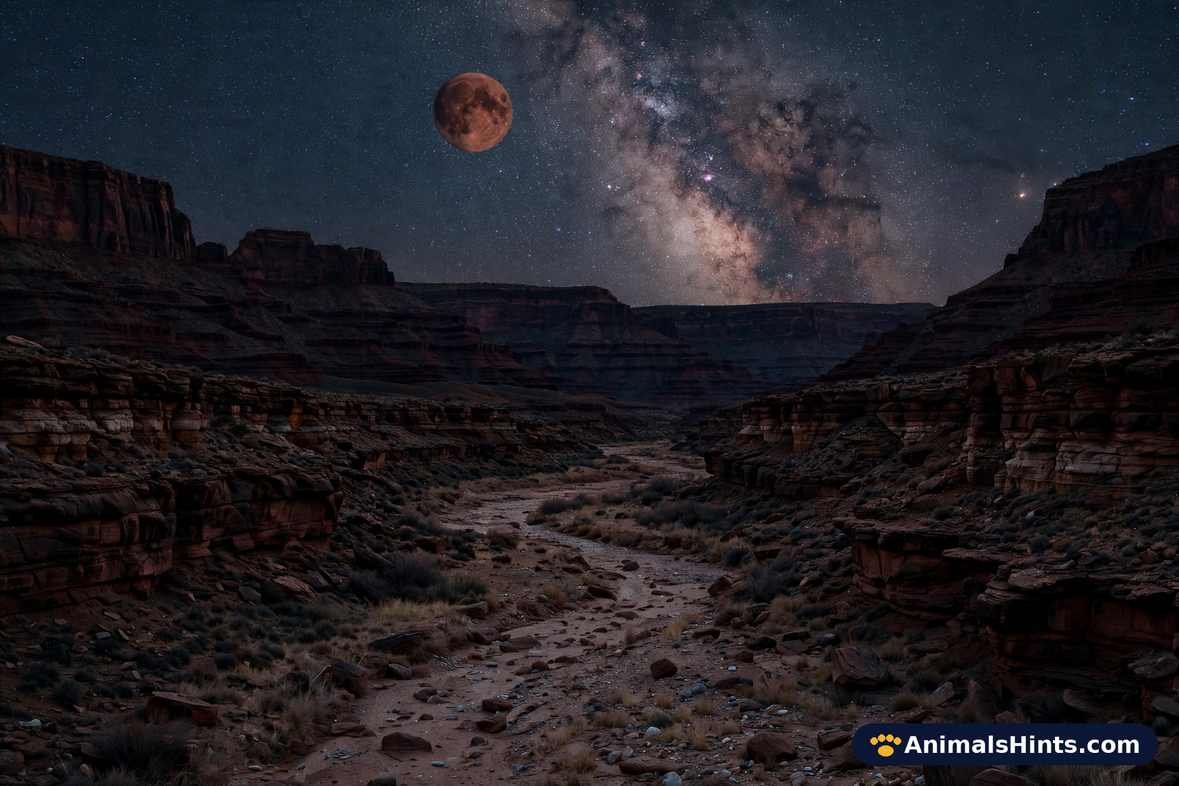
Old Chinese tales gave the devouring role to an animal too — most often a great dog in the Chinese and Korean tellings, in others a dragon — and the human answer across much of Asia was the same as in the Andes: drums, gongs and noise to frighten the devourer away from its meal. The pattern is worth pausing on. Civilisations that never met each other looked at the same darkening Moon and independently produced a creature that was eating or attacking it, and a noisy crowd trying to stop the meal.
West Africa holds two documented entries that between them correct most of what is loosely said about African eclipse folklore. Among the Jukun of Nigeria, a lunar eclipse meant the Sun had caught the Moon, and drumming was used to urge the Sun to let its captive go. Among the Batammaliba of Togo and Benin, an eclipse is a fight between the Sun and the Moon — and the custom that answers it is not fear but peacemaking: people use the eclipse to settle their own feuds and old angers, setting the lights an example of reconciliation. Cultural astronomers describe that custom as alive today, which makes it one of the few eclipse traditions in this article that is still practised in its old form.
Biblical Meanings of Blood Moon or Red Moon
Three passages of the Bible speak of the moon turned to blood, and they are the reason the phrase carries the weight it does in the English-speaking world. They are quoted here in the King James Version, in full, because short quotations of these verses are usually where the trouble starts.
The first is the prophet Joel, describing the day of the LORD:
“The sun shall be turned into darkness, and the moon into blood, before the great and the terrible day of the LORD come.” (Joel 2:31)
The second is the same words on the lips of Peter, preaching at Pentecost in Jerusalem and presenting the events of that day as what Joel had spoken of:
“The sun shall be turned into darkness, and the moon into blood, before that great and notable day of the Lord come:” (Acts 2:20)
The third is in the Revelation, at the opening of the sixth seal:
“And I beheld when he had opened the sixth seal, and, lo, there was a great earthquake; and the sun became black as sackcloth of hair, and the moon became as blood;” (Revelation 6:12)
Read in their own contexts, the three texts do a consistent thing: they place a blood-red moon among the cosmic signs attending the day of the Lord — judgement and upheaval imagery, written as prophecy and apocalypse. What they do not do is also worth recording. They do not describe the mechanism of an eclipse, they do not attach the sign to any calendar date, and the Acts passage presents Joel’s words as already being fulfilled in the events Peter’s audience was witnessing. Christian readers have understood the verses differently ever since — some as a literal future sign still to come, some as prophetic imagery for upheaval, some as fulfilled at Pentecost on Peter’s own showing. This article quotes the texts exactly and leaves the theology where it belongs, with the reader. What happened when one modern movement did attach the verses to specific dates is documented history, and it has its own section next.
The 2014–15 Tetrad and the Blood Moon Prophecy
A tetrad is a run of four total lunar eclipses in a row, spaced about six months apart, with no partial eclipse in between. Between April 2014 and September 2015, exactly such a run occurred — and its four eclipses, on 15 April 2014, 8 October 2014, 4 April 2015 and 27–28 September 2015, each fell on the Jewish feasts of Passover or Sukkot. That coincidence became a publishing phenomenon. Pastor Mark Biltz had promoted the pattern’s significance from around 2008, and Pastor John Hagee’s 2013 book Four Blood Moons carried it to a bestseller audience: the tetrad, falling on the feasts and matching the sequence of Joel, Acts and Revelation, was presented as a signal that world-changing events — centred on Israel, and read by many followers as the beginning of the end times — were at hand.
The documented outcome can be stated without heat. The four eclipses arrived exactly when astronomers had long catalogued them, because tetrads and feast days are both products of the Moon’s calendar. The end-times events the prophecy led its audience to expect did not occur on that schedule; Biltz’s separate expectation of the Second Coming in the autumn of 2015 passed unfulfilled, while Hagee himself had been careful not to stake the claim on one specific dated event, framing the tetrad as a signal that something was about to change. The astronomical footnotes matter too, and critics made them at the time: because the Jewish calendar is lunar, about one eclipse in six falls on Passover or Sukkot by simple arithmetic; tetrads themselves are not rare, with sixty-two counted since the first century and the 2014–15 run only the second of eight in this century; and three of its four eclipses were not visible from Israel at all, with only the very end of the last one catching the country.
None of that is written here in mockery, and none of it endorses the claim either. The verses in the previous section are scripture, and they stand as they are. The 2014–15 prophecy was a modern claim built on top of them, by named authors, in dated books, against a dated sky — and claims of that kind belong to the checkable record, where this one now sits.
Blood Moon Rituals Spells and Witchcraft
In contemporary pagan and witchcraft practice, a blood moon is treated as a full moon at maximum intensity, and the ritual calendar adjusts accordingly. The activities described by practitioners are mostly quiet ones: water, crystals and tools set out in the moonlight to be charged; altars refreshed; meditation and divination attempted while the Moon is red; and release work of the kind attached to the meanings section above — writing down what is ending, and burning, burying or dissolving the paper as the eclipse peaks. This section describes what practitioners say they do; it teaches no spell, and it promises no result for any of it.
Practitioners do not speak with one voice about the night, and the disagreement is worth printing. A substantial strand of modern witchcraft advises against spellwork during an eclipse altogether, holding eclipse energy too volatile and unpredictable to aim — better, on that view, to watch, to rest, and to let the event pass without trying to use it. The two camps share the same premise, that the night is unusually charged; they differ only on whether that charge is a tool or a warning. Older folk magic had its own uses for eclipse nights, mostly protective — charms against the danger the darkened Moon was believed to carry — which connects the modern practice back to the myths in the next section.
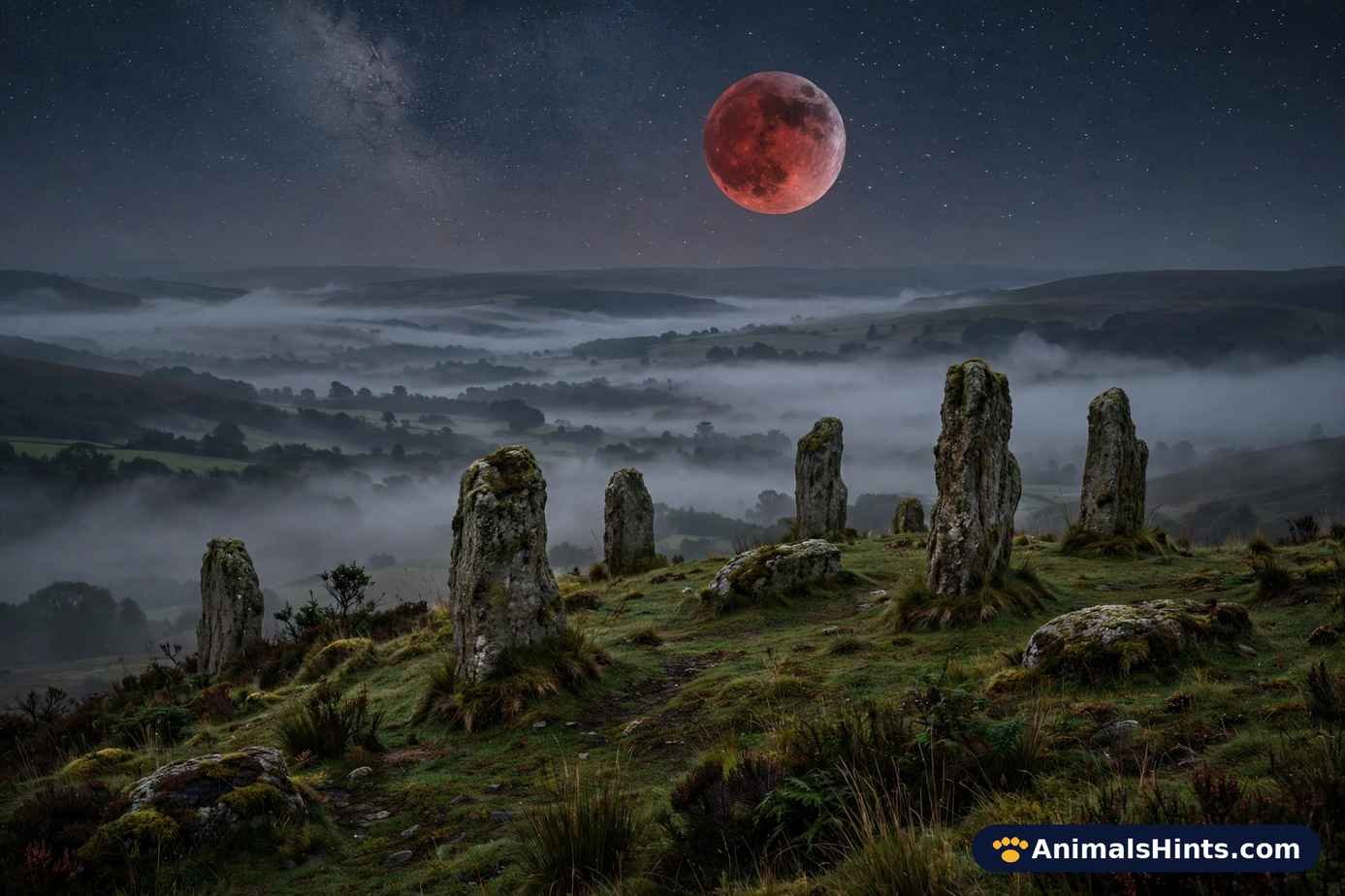
Myths and Superstitions Associated with Blood Moon
Read the cultural section again and a single skeleton shows through most of the world’s eclipse myths: something up there is attacking the Moon — a jaguar, a demon’s severed head, a troop of demons, a hungry dog, the Sun itself — and the Moon’s red face is a wound. The variations are local; the shape is nearly universal, from the Andes to Mesopotamia to West Africa. The human parts rhyme as well: noise to drive the attacker off, prayer for the threatened king or god, or, in the Batammaliba custom, peace made on Earth to encourage peace in the sky.
Around that old skeleton, later centuries grew a looser coat of superstition, and the honest way to print these is as beliefs that have been held, not as findings. A blood moon has been blamed, in one place or another, for earthquakes, floods, storms and the outbreak of wars; credited with unsettling minds — the very word lunatic descends from luna, the Moon — and with restless, badly behaved nights; treated in some folk traditions as a sight pregnant women should not look upon; and read on farms as a harvest sign, good or bad depending on the region telling it. The disaster belief survives every eclipse for an arithmetical reason: eclipses happen somewhere every year, trouble happens somewhere every day, and the two will keep coinciding forever without either one causing the other. No link between a blood moon and any earthly disaster has ever been demonstrated, and the astronomers who can predict the Moon’s shadow to the minute are the same people who can say that most plainly.
Is it Good or Bad Omen to Observe Red Moon
The traditions answer this question in opposite directions, and the article’s honest summary is that the omen is in the tradition, not in the Moon. On the dread side stand the oldest records: a Mesopotamian eclipse endangered a king, the biblical verses bind the red moon to a day of judgement, and folk superstition across several continents treated the sight as a warning to stay indoors and wait for the light to come back. On the renewal side stand records just as real: a Hupa Moon wounded and healed by his wives, Batammaliba neighbours settling their feuds under a fighting sky, and the whole modern vocabulary of transformation and release in the meanings section above.
The black spiritual meaning — the reading of darkness, the unseen and the shadow side — supplies most of the vocabulary of the darker interpretation, and it is worth noticing that even that reading is double-edged in the sources: the shadow is where things are hidden, but also where they rest and are remade. As for the act of observing itself, astronomy’s answer is complete. Watching a blood moon harms nothing and no one; it is ordinary moonlight, considerably dimmer than a normal full moon, falling on an ordinary night. A watcher can bring dread to it or gratitude to it, and the Moon will run through its shadow on schedule either way.
When Is the Next Blood Moon, and How Can You Watch One?
Because eclipses are computable centuries ahead, this is the rare omen with a published timetable, and the dates here are taken from the standard eclipse catalogues. The most recent total lunar eclipse fell on 3 March 2026 and was visible across Asia, Australia and the Americas. The next blood moon follows on 31 December 2028 — a New Year’s Eve eclipse, with the whole event, from first penumbral touch to last, running five hours and thirty-six minutes — and after that the next total eclipse comes on 21 December 2029. Between the 2026 eclipse and the 2028 one, the catalogues list only partial and penumbral lunar eclipses: the Moon will keep its silver colour, at most nicked by shadow, until the year turns.
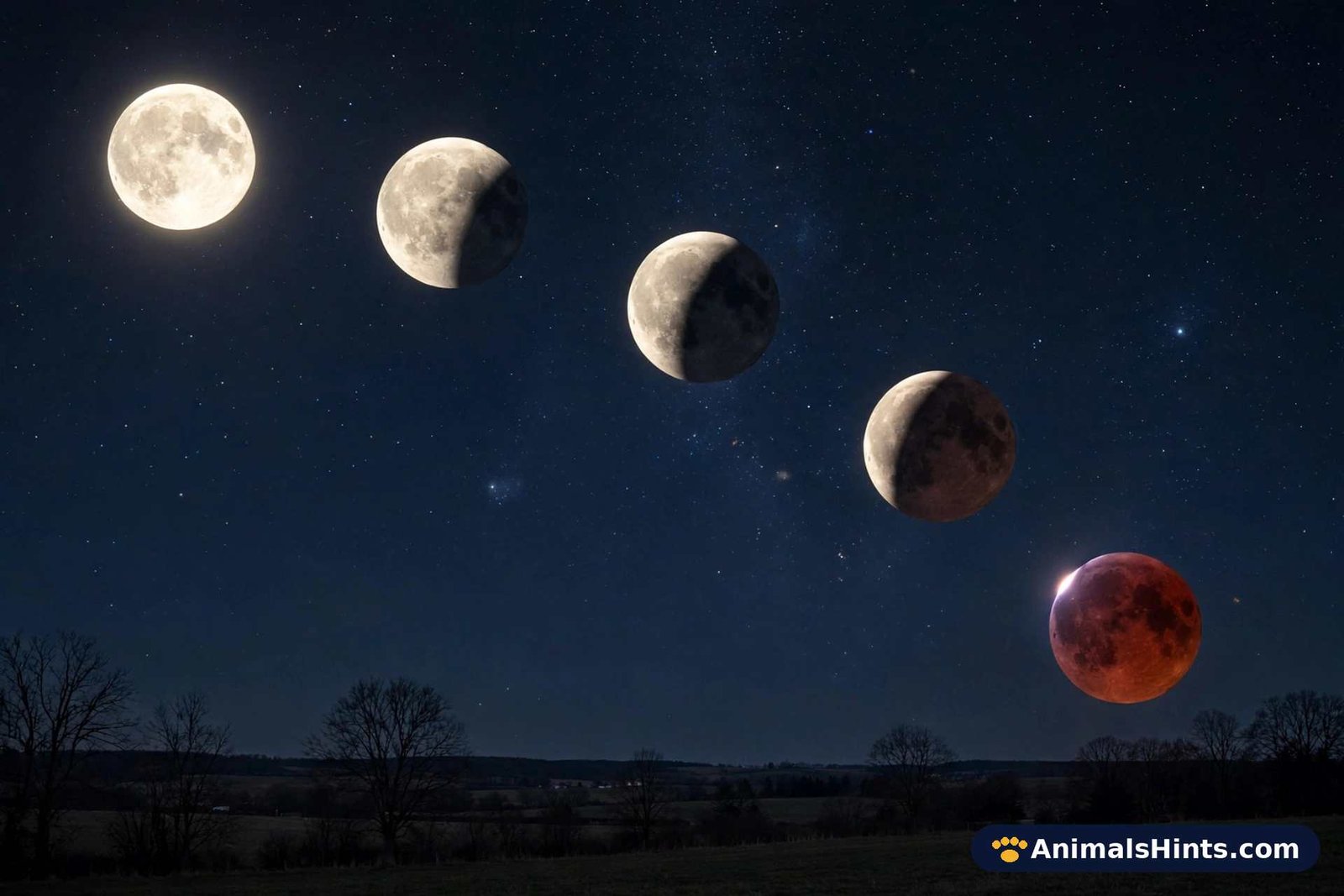
Watching one asks almost nothing of you, which is part of its charm. No eye protection is needed — unlike a solar eclipse, a lunar eclipse is only ever moonlight, and dimmed moonlight at that — and no telescope either, though binoculars deepen the colour and show the shadow’s curved edge crossing the craters. The whole night side of Earth sees the same phases at the same moment, so the only local facts to check are your own clock time and your weather. Give it time: the full sequence runs for hours, the red totality is the centrepiece rather than the whole show, and a clear view of the sky where the full moon rises is all the venue there is.
Final Thoughts
One event, and at least four literatures written about it. Astronomy explains the blood moon completely — a tilted orbit, a straight line, a cone of shadow, and sunlight strained red through the air of the Earth — and the explanation takes nothing away from the sight. Scripture gives it three lines that have outlasted empires and still anchor the phrase in the language. The old cultures give it jaguars and demons, substitute kings and drummers, a Moon with twenty wives and neighbours making peace under a fighting sky. Modern spirituality gives it a vocabulary of endings, shadows and fresh starts. The meanings are real as meanings; they have genuinely moved the people who hold them. The shadow is real as a shadow. A reader can honour both facts at once, and the next chance to do it under a red Moon is 31 December 2028.
Blood Moon Questions, Answered (FAQ)
What is a blood moon, in one sentence?
A blood moon is a total lunar eclipse: Earth stands exactly between the Sun and the full Moon, and sunlight filtered through Earth’s atmosphere turns the shadowed Moon red.
When is the next blood moon?
The next total lunar eclipse falls on 31 December 2028; the most recent was on 3 March 2026, and only partial and penumbral eclipses occur in between.
Is it safe to look at a blood moon?
Yes. It is ordinary moonlight, dimmer than a normal full moon, and no eye protection of any kind is needed — the safety rules people know belong to solar eclipses.
How long does a blood moon last?
The red total phase can run from a few minutes to about an hour and three quarters; the century’s longest, on 27 July 2018, held totality for one hour and forty-three minutes.
Does a blood moon mean something bad is coming?
That is a reading traditions place on the event, not a property of it: astronomically it is a predictable shadow, and cultures have read the same sight as an attack, a judgement, a healing and a fresh start.
What does the Bible say about the moon turning to blood?
Joel 2:31 and Acts 2:20 describe the moon turned to blood before the day of the Lord, and Revelation 6:12 pictures the moon becoming “as blood” at the opening of the sixth seal — all three are quoted in full in the Bible section above.
One term in this article deserves its source named plainly, for readers who like the mechanism stated properly: the reddening of the eclipsed Moon is Rayleigh scattering — the scattering of sunlight by air molecules, which lets the long red wavelengths through while the blue is scattered away, worked out mathematically by Lord Rayleigh in 1871.