Cat Sleeping Above My Head Meaning Spiritual: 12 Meanings, Culture and the Real Reasons
When people ask about the cat sleeping above my head meaning spiritual, the tradition’s answer is one of the kindest in the whole catalogue of animal signs: a cat that curls up on your pillow, right beside your crown, is read as a small guardian — an animal that has chosen the most vulnerable hour of your day to sit watch over your dreams, your thoughts and your rest.
That reading has deep roots. Cats have been treated as protective, half-otherworldly creatures for thousands of years, from the temples of Egypt to the folklore of the Scottish Highlands, and the pillow is a pointed place for the belief to land: in the chakra framework used by modern spiritual writers, the top of the head is the crown chakra, the seat of consciousness and connection, so a cat sleeping there is read as a cat sleeping at the gate of the mind itself.
Below you will find the twelve meanings the tradition returns to, the cultural and religious record behind them, the old myths — including the one dark superstition — and then the other half of the truth: what cat behaviour science actually says about warmth, scent and trust, and the few health notes that genuinely matter when a cat shares your pillow.
Why Does Your Cat Sleep Above Your Head or on Your Pillow?
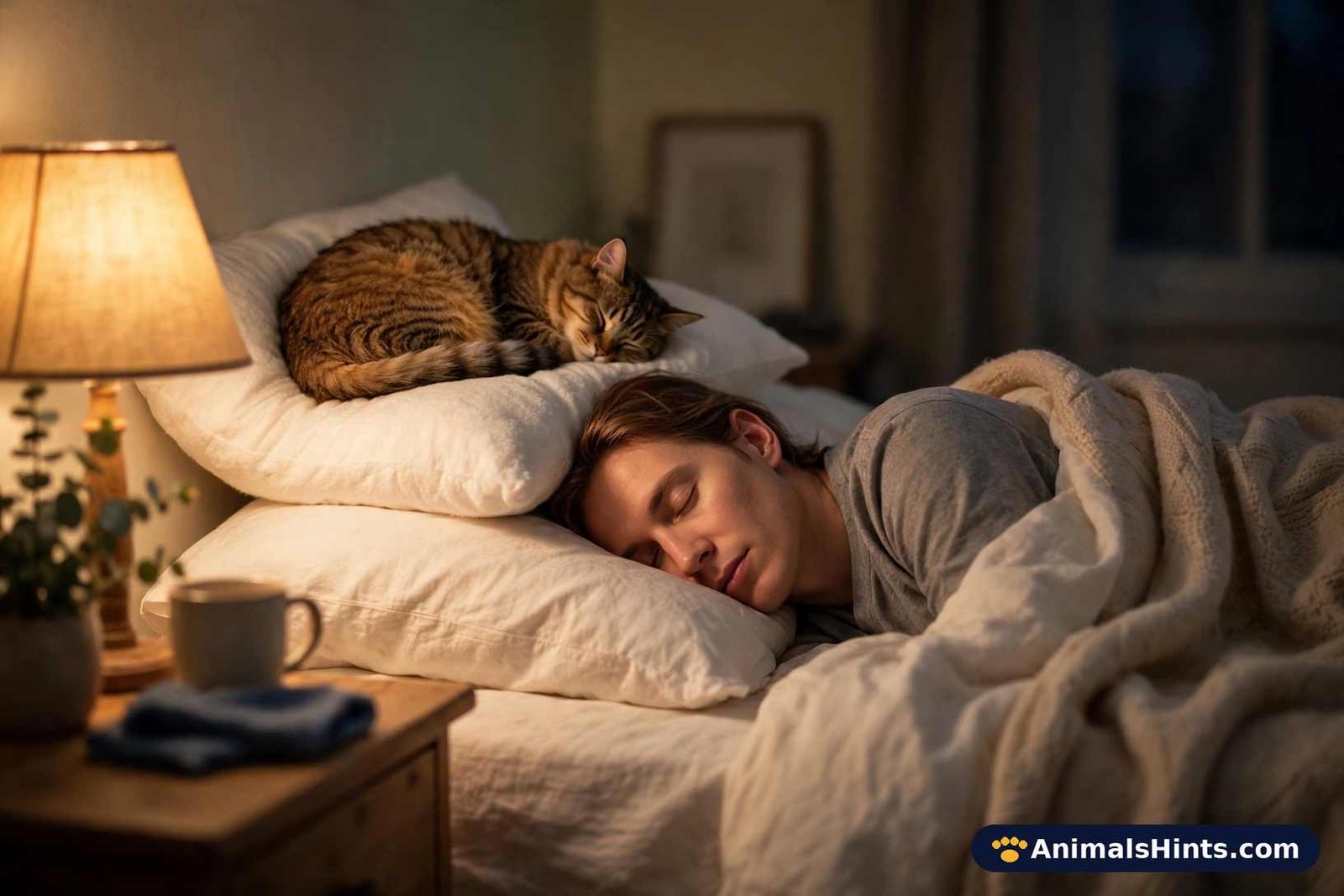
Start with the spot itself, because the whole reading hangs on it. Your pillow is not a random square of the bed. It is the highest, softest, warmest-edged place in it, it carries your scent more strongly than anywhere else in the house, and it sits directly against your head — and every layer of the traditional reading works off one of those facts.
The spiritual layer works off the last one. In the chakra system that modern spiritual writing uses, the crown of the head is the crown chakra — Sahasrara in Sanskrit — the energy centre associated with consciousness, intuition and connection to the divine. Writers in this tradition hold that cats are unusually sensitive to the unseen side of a household: to moods, to tension, to what they describe as the energy of a room. A cat that settles at your crown is therefore read as a cat drawn to the place where your own energy is most active, positioning itself — in the language of the belief — to guard it, balance it, or simply keep it company through the night.
The colour of the cat is sometimes given a layer of its own. Many writers in the tradition hold that a black cat brings the strongest protective charge of all, a reading this page returns to in the cultural section below, where it belongs.
None of this needs the cat to be doing anything mystical, and the tradition, at its most honest, does not claim otherwise. The claim is narrower and older: that where a cat chooses to sleep is never quite meaningless, because cats are choosy creatures, and the pillow above your head is the choosing place this page is about.
12 Spiritual Meanings of a Cat Sleeping Above Your Head or Pillow
1. Seeking Warmth
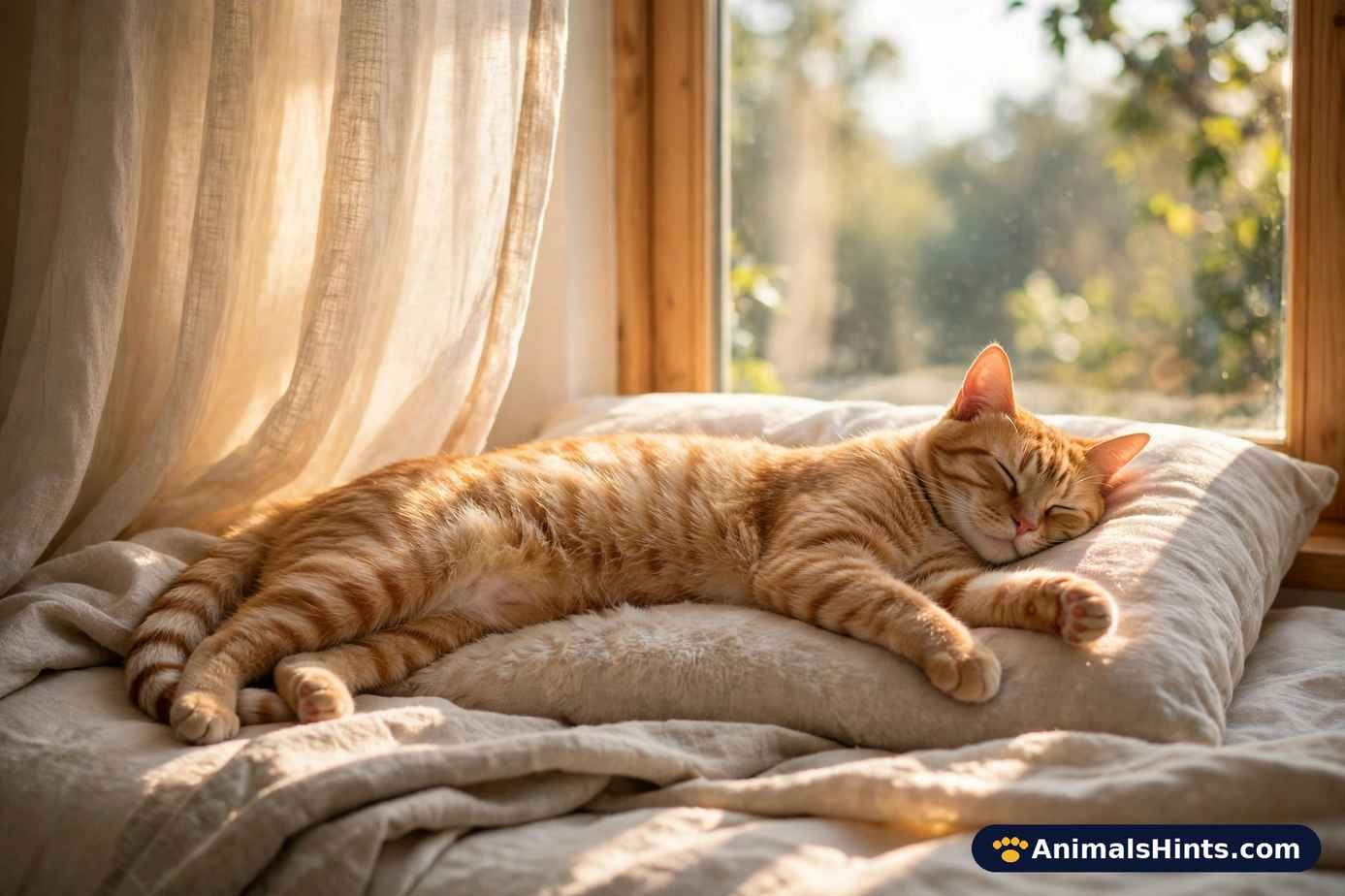
The first meaning is the humblest, and the tradition is content to start there: your cat is cold, and you are warm. A cat’s normal body temperature runs higher than a person’s — PetMD puts the range at about 100.5 to 102.5 degrees Fahrenheit — and cats rest most comfortably at temperatures well above a normal bedroom’s, so a sleeping cat is always, in part, a heat-seeking one. Your head gives off steady heat all night and barely moves, which makes the pillow beside it prime territory.
The spiritual reading builds directly on that physics. In the symbolic language of the tradition, warmth is never only warmth: it stands for safety, welcome and life itself. A cat drawn to the warmth of your crown is read as a cat drawn to the warmth of your presence — basking, as the writers put it, in the glow of the person it trusts. The meaning is deliberately double: the body seeks heat, and the bond seeks home, and the cat on the pillow is doing both at once.
2. Comforted by Your Scent
A cat’s world is built out of smell far more than ours is. Veterinary sources note that cats carry scent glands in their cheeks and chin and read the world through scent in a way humans can barely imagine — and nowhere in your home is your scent stronger or more concentrated than in your hair and your pillowcase. To your cat, that pillow does not just smell nice. It smells like you, which to a cat means it smells like safety, food, routine and home.
Spiritually, modern writers extend the same point into their own vocabulary: your scent is treated as the physical carrier of your presence, so a cat that buries itself in it is read as a cat wrapping itself in your essence while you sleep. Owners notice the practical edge of this most when they travel — the cat that ignores the pillow all week often takes it over completely the night its person comes home, as if re-attuning itself to a scent that had begun to fade.
3. Showing Affection and Love
Of all twelve meanings, this is the one behaviourists and believers agree on most completely. Sleep is the most vulnerable thing a cat does. A cat that sleeps curled against your head — within reach of your hands, in the one place it cannot easily bolt from — is a cat that has decided you are family. Kittens sleep piled against their mother and littermates; an adult cat that recreates that pile with a human is extending kitten trust to a person.
It is the indoor echo of a choice cats make outdoors, too: the spiritual meanings of a stray cat coming to your house turn on the same act of voluntary trust, a cat that did not have to stay, staying. In the spiritual reading, that chosen closeness is the whole message. The cat is not performing a ritual. It is saying, in the only grammar it has, that your head is its favourite place in the world to be defenceless.
4. Marking Territory Spiritually
Cats are territorial, and the pillow is not exempt. PetMD’s explanation of why cats sleep on their people includes the plain one: a cat that sleeps on you and your bed is also scenting you, mixing its smell with yours and filing you both under “mine.” A cat’s cheeks, chin and paws all carry scent glands, and a night spent on your pillow leaves the pillow thoroughly claimed.
The spiritual writers take that same behaviour and read it upward. In their framing, the mingled scent is a mingled presence: the cat is not just claiming territory, it is anchoring itself to you, declaring the two of you a unit. Where the behaviourist sees a signature, the tradition sees a seal — the cat stamping its bond with you onto the place you sleep, night after night, until the claim and the comfort are the same thing.
5. Seeking Security
Turn the telescope around and the pillow looks different again: sometimes it is not you being guarded, but the cat seeking a guard. Cats are predators, but they are small predators, and sleep is when they are most exposed. Behaviourists quoted by Rover make the point directly — a cat rests easiest near the human it trusts, because your presence is its security system. The head of the bed helps too: it is elevated, it is still, and it has a clear view of the room.
The tradition absorbs this without embarrassment and reads it as mutual guardianship. The cat that climbs to the pillow for safety is, in the folk reading, taking up the watchman’s post at the same time — settling where it can both be protected and keep an eye on the room, the door and you. Security sought and security offered are, in this meaning, the same act seen from two ends.
6. Stress Relief and Comfort
Cats are close readers of a household’s weather. Owners and behaviourists alike observe that cats gravitate toward people who are ill, grieving or exhausted, and a cat that takes up the pillow position during a hard season of its owner’s life is commonly read — by its owner, at least — as a deliberate act of comfort. Your breathing, your warmth and your stillness calm the cat; the cat’s weight and purr calm you; the arrangement is a small machine for lowering two heart rates at once.
The spiritual reading calls this mutual healing and treats the timing as the sign: if the pillow visits begin or intensify when you are depleted, the tradition reads the cat as having noticed before you did. Whether or not you take the mystical version, the practical observation underneath it is worth keeping — a change in where your cat sleeps is a change worth noticing, for the cat’s sake as much as yours.
7. Spiritual Communication
This is the meaning that belongs most purely to the belief system itself. Cats have been cast as intermediaries between the visible and invisible worlds for as long as they have lived beside people — creatures that stare at empty corners, slip through the night, and answer to no one’s schedule. A cat that sleeps at your crown is read, in this strand of the tradition, as a cat stationed at the exact point where, in chakra language, your consciousness opens upward: a bridge animal doing bridge work while you dream.
Read it as literally or as lightly as your own beliefs allow. Even stripped of the metaphysics, the image carries the experience owners actually report: dreams that feel accompanied, a sense of not sleeping alone in the house of your own mind. The tradition’s claim is that this is communication. The cautious version is that it feels like it — and that the feeling is the meaning most owners take to bed with them.
8. Blessing and Protection
Here is the catalogue’s headline meaning, the one the whole page is named for. In the protective strand of cat lore — the oldest strand there is — a cat sleeping above your head is a blessing in the literal, old sense: a guard posted over you while you are helpless. The cat’s reputed sensitivity is the mechanism believers offer: an animal that notices what humans miss, placed where your thoughts and dreams are made, keeping both under watch.
Notice what the blessing is said to consist of. Not luck, not money, not fortune arriving tomorrow — just presence. The cat’s choice itself is the blessing: of all the warm, soft, safe places in the house, it picked the one beside your head. In a tradition full of dramatic omens, this meaning is strikingly domestic, and probably the truest to why the belief survives: it flatters no one and frightens no one; it simply says you are watched over.
9. Invoking Intuition
A quieter meaning follows from the same crown-chakra geography. If the top of the head is where intuition lives in the chakra map, then a cat that insists on sleeping there is read as a nudge aimed at that faculty: pay attention, trust the first feeling, listen to the quiet signal under the noise. Owners who keep dream journals sometimes report that the pillow-cat seasons are the vivid-dream seasons — an anecdote, not a finding, and the tradition itself usually presents it no more strongly than that.
Take this meaning the way it is offered, as an invitation rather than a prediction. The cat is not delivering messages; in the reading, it is pointing at the part of you that receives them. Whether you file that under spirituality or under the simple effect of sleeping beside a calm animal, the practical fruit is the same: a person who wakes up beside a cat tends to start the day a little more attentive than one who does not.
10. Symbol of Transformation
Cats are the animal kingdom’s standing emblem of self-possession and change — the creature that lands, sheds, reinvents its day around its own weather. A cat that takes up residence at your crown is read, in this meaning, as a marker laid on a threshold: something in the sleeper is shifting. New phase, new clarity, an old skin loosening. The crown placement does the symbolic work again — transformation in this reading is not about your circumstances but about your head: how you think, what you believe, who you are becoming.
The tradition is refreshingly unspecific here, and that is the honest way to hold it. No reputable strand of the lore claims the cat can tell you what the change is. The claim is only that the cat’s arrival at the gate of your mind, night after night, is a fitting emblem for a season of change — a small, warm punctuation mark at the top of the page of your life.
11. Embracing Independence
The eleventh meaning is the paradox the whole species is built on. The cat on your pillow could sleep anywhere. It is the least dependent creature in your house — fed by you, certainly, but emotionally self-employed, affectionate strictly on its own terms. That is exactly why its presence reads as it does: chosen closeness from an animal that chooses nothing out of obligation. In the spiritual reading, the pillow cat becomes a small nightly lesson in how love is supposed to work — near, but never owned; attached, but never clinging.
Owners tend to recognise themselves in this one. The cat models the balance most people are trying to strike in their own relationships: how to be fully connected to another being and fully yourself at the same time. The cat manages it by simply leaving when it wants to — which is why, when it stays, the staying means something.
12. Offering Healing Energy
The last meaning is the one with a laboratory footnote, and the footnote deserves its honesty. Cats are widely believed, in the healing strand of the tradition, to channel restorative energy through their presence and their purr — and a cat purring directly beside your ear, at the seat of your consciousness, is that belief at maximum strength. The purr is certainly real, and it is genuinely measurable: in a widely cited 2001 analysis, bioacoustician Elizabeth von Muggenthaler recorded the purrs of 44 felids, domestic cats among them, and found strong frequencies between 25 and 150 hertz.
Her further suggestion — that those frequencies overlap with ones used in some vibration therapies, and that purring might therefore be a built-in healing mechanism — was published as a question, not a conclusion, and it remains a hypothesis: no study has shown a purring cat healing a human body. This page prints the finding and the limit together, because the tradition is at its best when it does. What is not in doubt is the smaller, human-scale effect: people reliably find a purring cat calming, and a cat that delivers that calm to the pillow, nightly, is offering the one healing service it can actually perform.
What Science Says: The Real Reasons Cats Sleep by Your Head
Strip the symbolism away and the pillow habit still makes complete sense — arguably more sense, which is why the belief built on it has lasted. Behaviour science gives the spot a four-part explanation, and every part is checkable.
Warmth. This is the engine of the whole behaviour. A cat’s normal body temperature is higher than a human’s — roughly 100.5 to 102.5 degrees Fahrenheit, per PetMD — and cats are desert-descended animals whose comfort zone sits far above a thermostat’s setting: their thermoneutral zone, the range in which they stay warm without spending energy, is commonly cited at roughly 86 to 97 degrees Fahrenheit. A bedroom at 68 degrees is, to a cat, a chilly room with one reliably warm piece of furniture in it: you. Your head and neck give off steady heat all night, the pillow traps it, and the cat collects it.
Stillness and height. Your head is the stillest part of you. Arms flail, legs kick, torsos roll; the head mostly stays where it was put, which makes the pillow the safest berth on a bed occupied by a much larger animal. It is also the highest — and cats, who are both hunters and potential prey, rest best with elevation and a view. Cat behaviourists even have a name for the head-end habit: behaviour consultant Mikel Delgado has described cats’ bedtime “pillowing” — the deliberate choice of the pillow as the sleeping station.
Scent. The pillow is the most you-smelling object in the house, and scent is a cat’s primary filing system. Sleeping in your scent is comfort; adding its own — cats carry scent glands in the cheeks, chin and paws — is bookkeeping. The two scents mingled on one pillowcase are, in feline terms, a shared address.
Trust. Above all, location is a verdict. Cats sleep in long shifts — a typical adult puts in 12 to 16 hours a day, in naps scattered across the clock, being crepuscular creatures most active at dawn and dusk — and they spend those vulnerable hours where they feel safest. A cat that spends them against your head has assessed the whole house and chosen you. Kittens begin life sleeping in a pile on their mother; the adult on your pillow is running the same program with the person it has.
Cultural and Religious Significance
The protective reading of the pillow cat is not a modern invention, and its roots are worth setting out accurately — including where the popular version of the story runs ahead of the record.
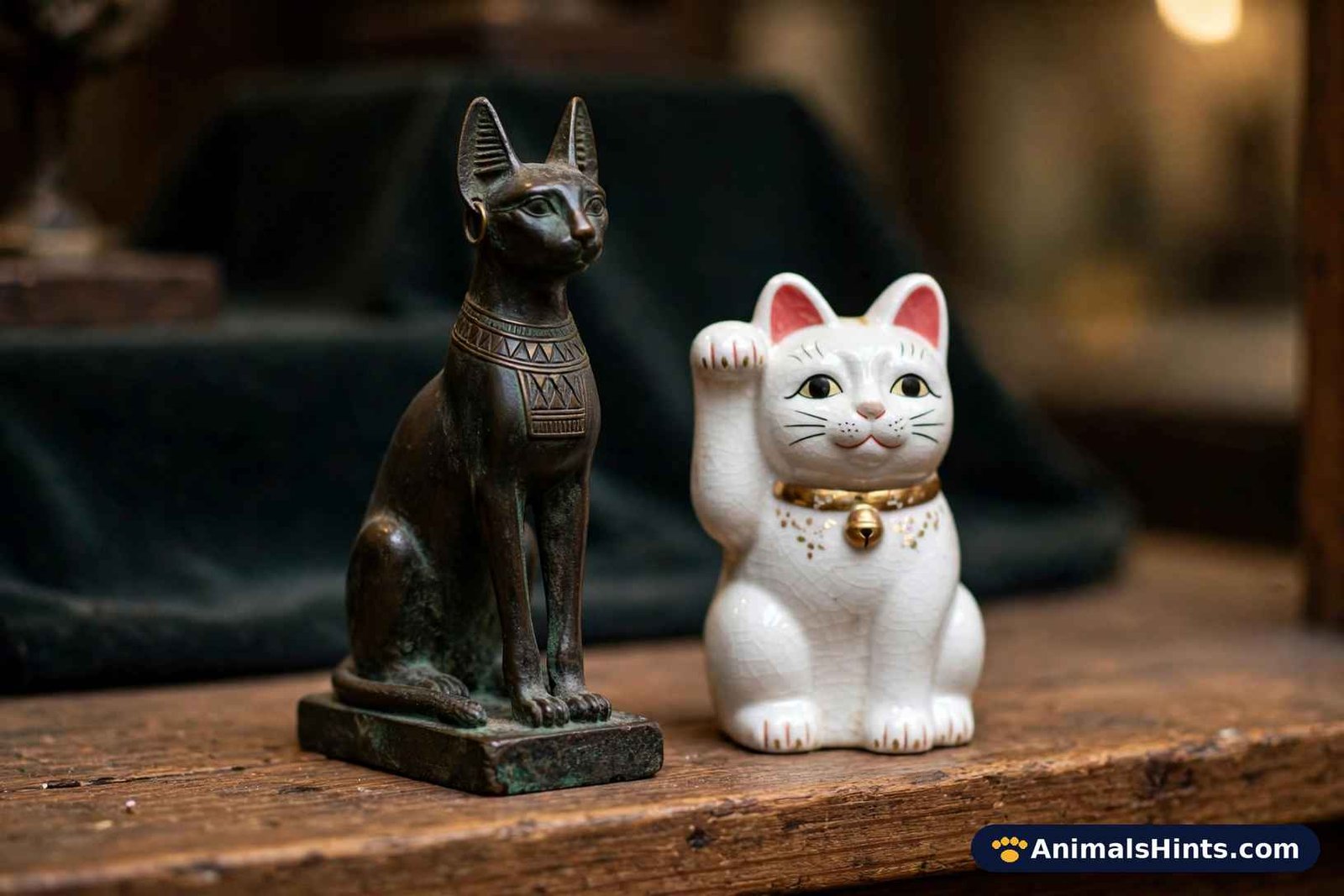
Egypt. The oldest and firmest root. In ancient Egypt the cat was bound up with Bastet, the goddess of the home, domesticity, cats, fertility and childbirth, whom the World History Encyclopedia describes as the protector of the home against evil spirits and disease. Depicted in her later form as a woman with a cat’s head, with her cult centred on the city of Bubastis, Bastet made the household cat a sacred presence rather than a mere pet: to have a cat in the house was to have the goddess’s protection in it. A cat keeping watch over a sleeping person is a direct descendant of that idea.
Japan. The lighter root. Japan’s maneki-neko, the beckoning cat figurine with one raised paw, is kept in homes and shops as an emblem of luck and prosperity — the cat as a bringer of good fortune rather than a guard against bad. A cat that chooses your pillow sits comfortably inside that frame too: fortune that walks in on its own four feet and stays the night.
The Celtic strand — with a correction. Popular retellings, the competitor’s included, often say loosely that “Celtic tradition” made cats gatekeepers between worlds. The documented Highland record is more specific and considerably stranger. Scottish folklore — with Irish parallels — tells of the cat-sìth, a fairy cat as large as a dog, black with a white spot on its chest, which was believed able to steal the soul of a newly dead person by passing over the body before burial; families kept watch over their dead in a vigil called the Late Wake to prevent exactly that. Another strand held the cat-sìth was no fairy but a witch who could take cat form nine times. That is the real Celtic cat: not a cosy gatekeeper but an ambivalent power, respected the way deep water is respected. The modern “guardian between worlds” phrasing is a soft retelling of it.
The modern strand. The claim that cats absorb negative energy from a home or a person belongs to contemporary spiritual writing rather than to any ancient doctrine — which does not make it insincere, only young. It is best read as the newest layer on a very old intuition: that a house with a cat in it feels watched over.
And the colour note from the opening section lands here: writers in this tradition consistently give the black cat the strongest protective charge, a reading with its own long and tangled history — our guide to black cat spiritual meaning works through that record in full.
Myths and Superstitions Associated with a Cat Sleeping Above Head on Pillow

The pillow cat has attracted folklore the way the cat itself attracts sunbeams, and the myths split neatly into the kind ones and the one dark one.
The kind ones first. Across parts of Europe, folk belief held that a cat sleeping near a person’s head would absorb bad dreams or keep nightmares from reaching the sleeper — the cat as a filter stationed between you and the night. It is the protective meaning wearing older clothes, and it survives today mostly as a figure of speech: owners still say their cat “guards their dreams” without believing a word of it literally, and meaning every word of it emotionally.
In the Middle East and parts of Asia, the folk current runs warmer still: the cat is a blessed animal, and one that chooses to rest near you confers a kind of endorsement — your household, and by extension your spirit, is in good standing. Modern spiritual writers add their own gloss: the cat as mirror, its pillow habit reflecting the state of your mind back at you — restless cat, restless thoughts; settled cat, settled house.
The dark one deserves daylight. An old and persistent superstition, recorded across Europe and America, held that a cat could steal a sleeping baby’s breath — even that cats deliberately suffocated infants. There is no truth in it as an account of feline intent: it is a fear-story from the centuries when sudden infant death had no other explanation, and the cat, nocturnal and silent, was the nearest suspect. What the myth accidentally preserves is a sensible rule in frightening dress — babies and animals should not share a sleep surface, a point modern safe-sleep guidance makes on entirely practical grounds, and one this page returns to below. The cat was never stealing breath. It was, as ever, stealing warmth — and the two claims should not be confused, in either direction.
Should I Be Concerned?
Spiritually, the tradition’s answer is unanimous: no. There is no strand of the pillow-cat lore, kind or dark, that reads a cat sleeping above your own head as a warning aimed at you — the breath myth was about infants, and it was wrong. For an adult, every tradition that has an opinion files the habit under blessing, bonding or both. Cats are famously selective; a cat that spends its most vulnerable hours against your head is paying you the highest compliment in its power.
The practical answer is nearly as short, and it belongs to the next sections: the honest concerns are not spiritual at all. They are allergies, light sleep, and a short list of household situations — a baby in the bed, a weakened immune system — where the pillow should be renegotiated. If none of those is you, the tradition and the behaviourists give the same advice from opposite directions: enjoy it.
There is one introspective use the tradition makes of the habit that is worth keeping even for sceptics. If your cat’s pillow visits are new, or suddenly constant, treat it as a prompt to check both ends of the pillow: a clingier cat can be an unwell or anxious cat, and a person being sought out nightly is sometimes a person running on empty. The cat is not a diagnosis. But it is a very observant housemate.
Is It a Good Sign? The Honest Verdict
Yes — with the honesty this page owes you about what “yes” means. As a spiritual sign, the pillow cat is as close to a uniformly good omen as this entire field produces: across the Egyptian root, the Japanese frame, the European dream-lore and the modern energy reading, a cat sleeping above your head is protection, trust and blessing, with the single dark exception of a breath myth that was never about adults and never true. No tradition in the record reads your cat’s favourite sleeping place as a threat.
As an animal fact, it is if anything better: a verdict of trust delivered nightly by the most fastidious creature in the house, for reasons — warmth, scent, stillness, safety — that reflect well on the home you have made. The two verdicts agree, which is rare in this catalogue and worth noticing. The pillow cat is a good sign in the precise sense that it signifies something good: a bond that exists, being renewed in the dark, one nap at a time.
Sleeping With Your Cat: The Health Notes That Actually Matter
For most healthy adults, sharing a bed with a healthy cat is a low-risk pleasure — but “most” is doing work in that sentence, and the exceptions are specific enough to name.
The documented risk is infection, and it is genuinely rare. A widely cited 2011 review in the CDC’s journal Emerging Infectious Diseases, “Zoonoses in the Bedroom,” collected the published cases of diseases passed to people through bed-sharing, kissing or licking by pets, and its conclusion was measured rather than alarmist: transmission happens, it is uncommon, and the risk concentrates in young children and people with weakened immune systems. The review’s practical core is pet hygiene, not separation — keep the cat’s vaccinations and flea and parasite control current, keep up with vet checks, and wash hands after handling the litter box.
Allergies are the commoner cost. Cat allergen settles deep into bedding, and a cat on the pillow puts it directly at your nose and eyes for eight hours; veterinary centres such as New York’s Animal Medical Center note that a pet in the bed can aggravate asthma and allergies, especially in children. If you wake congested, the pillow is the first variable to change.
The one firm rule is about babies. An infant should never share a sleep surface with a pet: safe-sleep guidance puts babies on their own clear, firm surface, and a cat — warm-seeking, heavy enough, and fond of exactly the soft spot beside a small head — has no place in it. Let the cat keep the grown-ups’ pillow and give the baby a room of their own. Beyond that, if anyone in the bed is undergoing treatment that suppresses the immune system, the bedroom door is the sensible line, and your doctor’s word outranks this page.
How to Give Your Cat a Spot of Its Own Beside You
If the pillow arrangement needs renegotiating — for a baby, an allergy, a new partner, or your own unbroken sleep — the trick is not to evict the cat but to outbid yourself. Every reason the cat chose the pillow can be matched by a better offer placed within reach of it.
Put a proper cat bed at the head of your bed, on a nightstand or a low shelf level with the mattress: height and proximity both preserved. Make it warm — a self-warming pad or a pet-safe heated bed speaks directly to the thermoneutral maths above. Dress it in your scent: a worn T-shirt over the cushion gives the new spot the one feature no shop-bought bed has. Then let the cat discover it rather than assigning it; a treat or two found there by “accident” does more than any amount of placing and replacing.
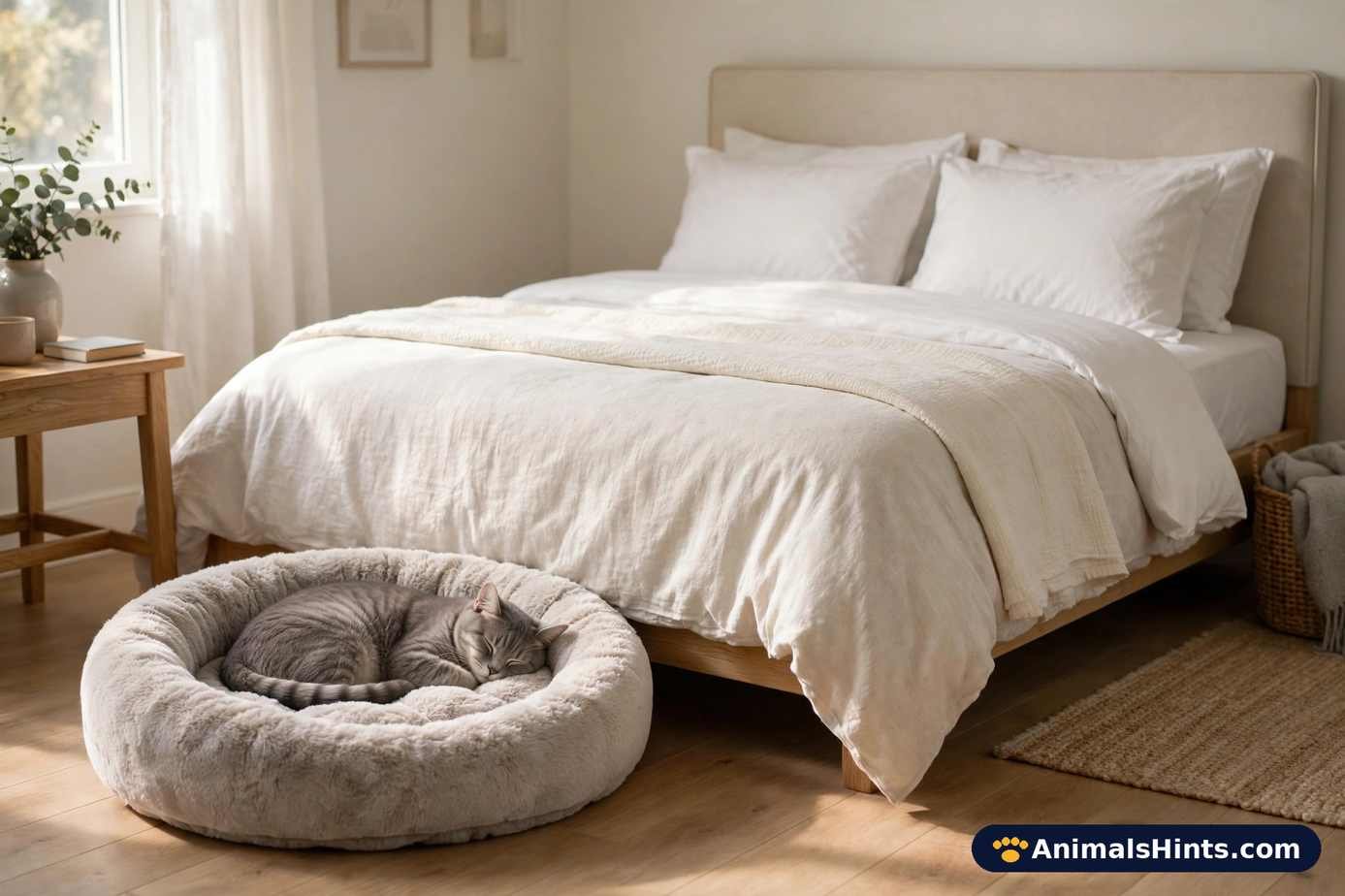
Expect the negotiation to take a week or two, and expect to lose some nights. You are not arguing with a habit; you are arguing with a verdict the cat reached for sound reasons, and verdicts change when the evidence does. What you are keeping — and this is the part the tradition would insist on — is the closeness itself. The cat beside your bed, at your head’s height, in your scent and your warmth, has lost nothing it actually wanted.
Final Thoughts
A cat sleeping above your head is a small event that two very different ways of knowing have both claimed, and unusually, both claims hold up. The behaviourist’s version: the warmest, stillest, best-smelling, safest square in the house is beside your head, and your cat — fastidious, desert-built, scent-led — has found it. The tradition’s version: a creature humans have treated as a guardian for three thousand years has posted itself at the gate of your mind, over your dreams, for the whole of the night.
You do not have to choose between the two accounts, because they are describing the same cat. The warmth is real, and so is the trust that makes the warmth worth seeking in that particular spot. Somewhere in the dark, most nights, the whole arrangement announces itself in the one sound no one has ever improved on: your cat, settled at your crown, purring — the oldest lullaby in the house, still on duty.
Frequently Asked Questions
What does it mean when a cat sleeps above your head spiritually?
In the spiritual reading, protection and connection: the cat is taken to be guarding your energy and your dreams from its post at the crown of your head, the seat of consciousness in the chakra framework. It is read as a blessing and a sign of an unusually strong bond.
Is my cat protecting me when it sleeps above my head?
The tradition says yes — that is its oldest and most consistent reading, from Bastet’s Egypt onward. The behavioural version agrees in its own terms: a cat sleeps where it feels safest, and a cat relaxed enough to sleep against your head is, at minimum, keeping you in the safest place it knows.
What does it mean if my cat always sleeps above my head?
Consistency is the message in both accounts. Spiritually, it is read as an established guardian habit and a deep, settled bond. Practically, it means your pillow wins on warmth, scent, stillness and height every night — and that your cat has voted, repeatedly, for you.
How should I respond to my cat sleeping above my head?
Mostly: accept the compliment. If the arrangement suits you, change nothing. If allergies, a baby or broken sleep say otherwise, offer a warm, raised bed beside your pillow dressed in your scent — and never an infant’s sleep surface, which should always stay pet-free.