Right Eye Watering Spiritual Meaning: Tears, Omens and Real Causes
When the right eye watering spiritual meaning is what you are searching for, the moment behind it is usually small and strange: one eye quietly fills and spills a tear while the other stays completely dry. You were not crying. Nothing obvious got in it. So why that eye, and why now?
Traditions around the world have read tears as signs for a very long time, and many of them give the right and left eyes different messages — including, in Indian omen lore, opposite messages for men and for women. Medicine reads the same moment differently again: usually as an irritation or drainage problem with a physical cause and a physical fix.
This guide walks through both views honestly. It covers the twelve classic meanings given to tears, what the right eye and the left eye are each said to mean, what the Bible and different cultures actually say, a straight answer on the luck question — and the real medical causes worth checking when one eye keeps watering.
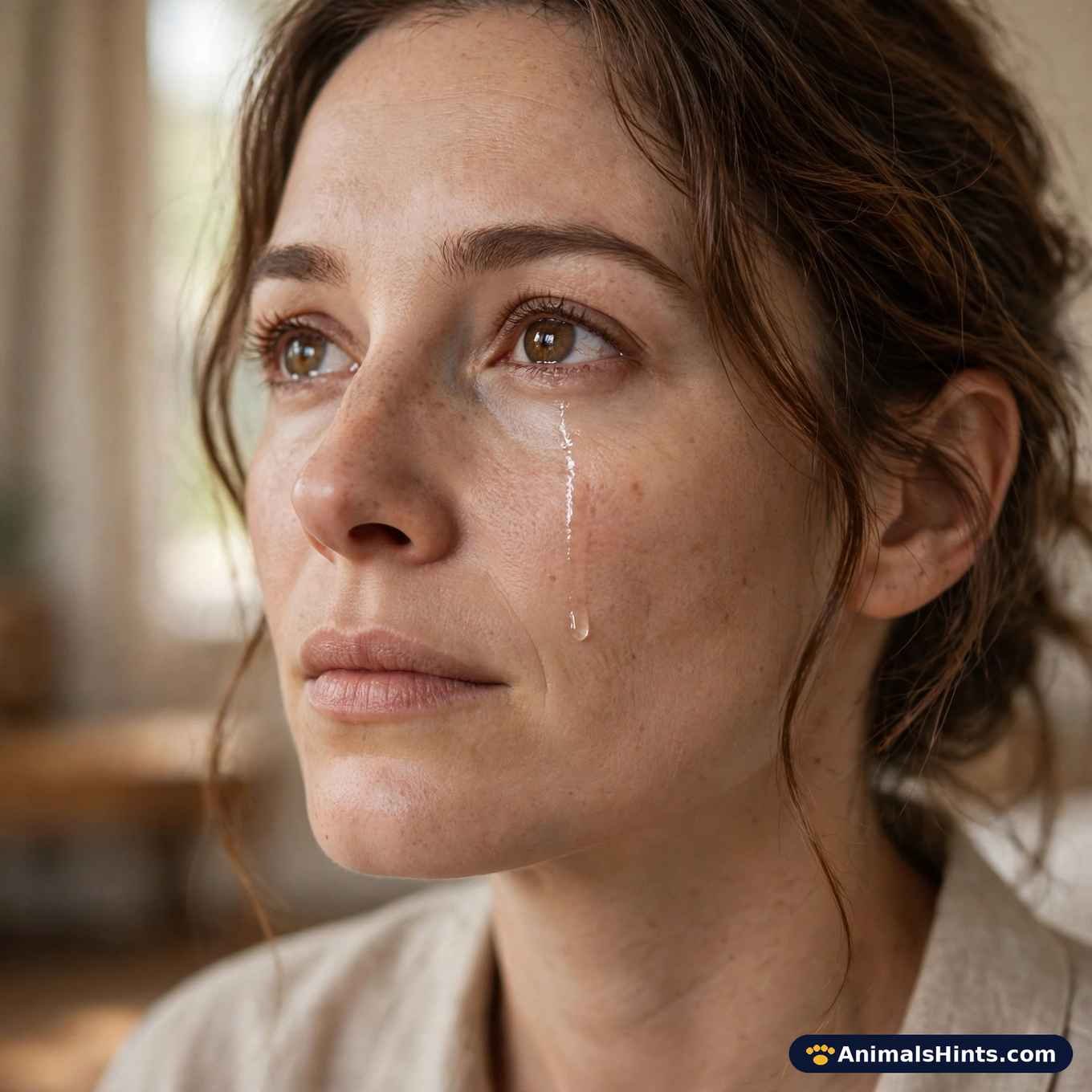
What Does Watery Eye Symbolize Spiritually?
Across spiritual writing, tears are one of the oldest symbols there are. Water cleanses, and tears are the body’s own water, so a watering eye is most often read as cleansing in progress: emotion, stress or heavy energy moving out instead of staying locked in. A tear that arrives without sadness is often read as the sign of something releasing before you have consciously felt it.
The eyes carry their own symbolism too. In tradition after tradition they are treated as gateways — doors between the inner life and the outer world — so moisture at the eye is read as something crossing that doorway: a feeling surfacing, an insight arriving, or grief leaving. Some writers add that tears are never wasted; older religious language even pictures them as gathered and kept, drop by drop, which is why a single unexpected tear can feel more significant than a whole bout of crying.
None of that makes a watering eye a message by itself. What the traditions actually offer is a set of readings — sometimes agreeing, often contradicting each other — and the sections below separate what each tradition genuinely says from what modern websites have added. First, though, the physical side deserves its own space, because it explains most cases.
It helps to see why tears, of all body signs, attract this much interpretation. Water is the element of emotion in nearly every symbol system — it flows, it cannot be held in the hand, it falls when a container is too full. Tears are the one place the body visibly overflows, and they arrive at exactly the moments people most want meaning: grief, relief, gratitude, awe. A sign that appears at emotional peaks will gather omens the way a harbour gathers boats. That does not make the omens true, but it makes them humanly understandable — and it explains why the readings cluster on release, cleansing and messages rather than on anything mechanical.
Why Does an Eye Actually Water? The Medical Explanation
Doctors have a plain word for a watering eye: epiphora. It means tears are overflowing — either because the eye is making too many of them, or because the tears it makes cannot drain away through the tiny ducts at the inner corner of the eye into the nose. Cleveland Clinic lists the common causes: allergies, blepharitis (inflamed eyelid edges), a blocked tear duct, dry eyes, styes, chalazia (blocked oil glands in the lid), and eyelids that turn inward or outward with age. It also notes that persistent watering can signal something that needs treatment, such as an eye infection or a blocked duct.
The dry-eye cause surprises people. The American Academy of Ophthalmology explains that eyes make three kinds of tears — basal tears that keep the surface moist all day, reflex tears that flood in when something irritates the eye, and emotional tears. When the eye’s surface is too dry, it triggers reflex tears, so a chronically watering eye can paradoxically be a dry eye. Mayo Clinic makes the same point: overproduction is often a response to a dry surface, alongside allergies, viral infections and foreign objects. Mayo adds that a blocked tear duct is the most common cause in babies and young children, while in older adults sagging eyelid skin and ducts narrowed by infection, inflammation or injury do most of the work.

Two modern habits feed the same dry-surface cycle. Long screen sessions cut the blink rate sharply, so the tear film evaporates faster than it is replaced and the eye answers with reflex watering — the watery eyes of a long laptop day are usually this, not emotion. Contact lenses can do something similar when they are worn too long or sit over a dry surface. Ageing narrows the drainage side of the system from the other direction: ducts tighten, lids loosen, and tears that would once have drained unnoticed begin to spill. None of these causes cares which eye you favour spiritually — but each one very often affects one eye before the other, which is why one-sided watering is so common and so rarely symmetrical.
The one-sided pattern matters here. When only the right eye waters, the cause is almost always in that eye: a duct that is narrower or blocked on that side, an irritant that reached one eye only, or a lid sitting slightly differently on that side. And on the question this article is about, medicine is blunt: doctors draw no meaning distinction between the left eye and the right. The AAO has confirmed there is no difference in the tears the two eyes produce. A watering eye is worth understanding spiritually if that framework speaks to you — but if one eye waters constantly for several days, or the eye is often infected, Mayo Clinic advises getting it examined, and pain, redness or any change in vision should be checked promptly.
12 Spiritual Meanings of Tears from Your Eyes
The twelve readings below are the classic set attached to tears in modern spiritual writing. They are beliefs, not facts — and where a reading rests on a claim that has actually been checked, that is said plainly.
1. Liberation Through Emotional Release
The most widely shared reading: tears mean something held in is finally moving out. A tear that comes without an obvious trigger is read as stored feeling — grief, relief, gratitude — releasing on its own schedule rather than yours. Writers in this tradition often point to the physical relief people report after crying as the sign’s proof: the body feels lighter because, on this reading, something genuinely left.
2. Right Eye Tears as a Sign of Gratitude
Right-eye tears are linked in this tradition with the outward-facing emotions: thanks, pride, joy at good news. The reading is that the right side expresses what you show the world, so a tear there marks an emotion too full to keep politely inside.
3. Awakening and Positive Change
A watering eye is also read as an awakening sign — the eye “opening” in both senses. On this reading, unexplained tears arrive at turning points: the end of a stuck period, the start of seeing a situation clearly. The image behind it is washing dust from a lens: the world was always there, but it comes into focus wet.
4. Joy and Sorrow Reflected Through Each Eye
This is the reading behind the famous rule that the first tear from the right eye means happiness, from the left eye pain, and from both eyes frustration. It should be labelled honestly: fact-checkers at Africa Check traced that rule to a social-media graphic circulating since at least 2011 — it is a modern internet claim, not an ancient belief, and the American Academy of Ophthalmology confirmed there is no evidence behind it and no difference between the tears of the two eyes. Many people still find it a poignant way to read a moment; it just is not old folklore.
5. Purification of Heavy Energy
Tears are read as washing — the water element clearing stagnant or heavy energy from around the eyes, which in several traditions are treated as the most spiritually exposed part of the body. A single eye watering is sometimes read more narrowly still: the side that waters is the side where the heaviness sat.
6. Right Eye as Purpose and Left Eye as Intuition
A common framework assigns the right eye to purpose, action and the outer world, and the left eye to intuition, memory and the inner world. A tear is then read by its side: right for something about your direction in life, left for something about your feelings and instincts.
7. Every Tear as a Sacred Expression
In this reading no tear is random or wasted. Tears are treated as a sacred expression in themselves — the body praying, grieving or giving thanks in a language older than words.
8. Tears From Both Eyes as a Sign of Transformation
When both eyes water together, the reading shifts from a one-sided signal to a whole-person one: transformation, a threshold being crossed, an old state dissolving. Ordinary crying fits here too — the traditions treat full tears as the mark of a real inner change rather than a passing mood.

9. Eyes as Gateways to Insight and Healing
Because the eyes are cast as gateways, tears at the gate are read as insight arriving or healing moving through — the moment something you could not see clearly becomes visible, emotionally speaking.
10. Emotional Regulation Through Tears
This reading has a foot in ordinary psychology: crying is one of the body’s regulation tools, a way the nervous system discharges overload. Spiritual writers adopt it as the idea that a tear is the system rebalancing itself — and that suppressing it stores the pressure instead. It is the least mystical of the twelve, and for many readers the most persuasive: the tear needs no sender, because the release itself is the meaning.
11. Tears as Messages From the Unseen
Some traditions read sudden tears as messages — from ancestors, from the divine, or from one’s own deeper self — especially when they arrive during prayer, meditation or remembrance of someone who has died. This is a belief held sincerely in many cultures; it cannot be verified, and it is presented here as exactly that.
12. A Call to Reflect on Life Changes
The gentlest reading: a watering eye is simply a prompt to pause. Whatever is changing in your life — ending, beginning, unresolved — the tear is taken as an invitation to reflect on it rather than a prediction about it. It pairs naturally with the journal-and-candle habit many readers of this genre keep: write down what the tear arrived in the middle of, and let the pattern, if there is one, show itself over time.
Spiritual Meaning of Tears from the Right Eye
The right eye collects the outward-facing readings. In the symbolism most modern writers use, the right side is the active, public, forward-moving side — purpose, work, the world — so tears from the right eye are read as emotion connected to your outer life: gratitude for something received, release after effort, or the first sign of a change arriving from outside. The Egyptian Eye of Horus is often mentioned in this context; in modern spiritual writing the right eye, linked with the sun and with Horus, is read as protection and healing, though that is a modern layering on an ancient symbol rather than a classical text about tears.
One major tradition, though, splits the right eye by gender — and it is the tradition with the oldest omen literature behind it. In Indian (Hindu/Samudrika) omen lore, water in the right eye is traditionally good luck for a man and bad luck for a woman, with the left eye exactly reversed; summaries of the belief state it in those terms for India, and the same sources note that in Nepal and India a woman whose left eye tears is the one considered lucky. That means the popular claim that right-eye tears are “especially positive for women” gets the Indian reading backwards — for women, this tradition puts the good sign on the left. The full comparison is tabulated in the section after next.
Underneath that flip sits an older piece of symbolism that several systems share. The right side is repeatedly paired with the sun — heat, activity, the masculine, the public world — and the left with the moon: coolness, receptivity, the feminine, the private world. That solar–lunar grammar is why the Indian omen lists can run the same rule across twitching, watering, itching and throbbing without changing direction: once the sides are assigned, every body sign inherits the assignment. It is also why “right equals good” fails as a summary — in this grammar the right side is not the lucky side, it is the male side, and luck depends on whose body the sign appears on.
Spiritual Meaning of Tears from the Left Eye
The left eye is written about here as the comparison, because the competitor tradition itself treats the two eyes as a pair — and because for this article’s subject the left eye is where several readings flip. Left-eye tears are assigned the inward-facing meanings: intuition, memory, dreams, the emotions you keep private. Where the right eye is said to speak about your direction, the left is said to speak about your feelings.
The regional readings follow that inward pattern but add their own turns. In Hawaiian belief, as recorded in superstition collections, a watering left eye is said to announce the arrival of a stranger — or, more darkly, a death in the family. In the Indian system described above, the left eye is the fortunate one for women and the cautionary one for men. And in the modern framework, a left-eye tear is read as the past surfacing — an old emotion asking to be felt — where a right-eye tear is read as the future arriving. These are attributed beliefs, each from its own culture, and they do not agree with each other; the next section puts them side by side so the disagreements are visible rather than smoothed over.
One practical consequence follows from the flip, and it is worth stating for readers who meet this topic through the twitching articles first: the left eye is not simply “the bad eye.” In the largest omen system in this article it is the good eye for half the population, and in Hawaiian belief it carries the famous arrival omen that the right eye does not. The left eye’s meanings are darker in tone — inward, lunar, private — but darker is not the same as unluckier, and the traditions themselves do not treat it that way.
Right Eye Watering vs Left Eye Watering: How the Meanings Differ
Side-by-side, the traditions look like this:
| Tradition | Right eye watering | Left eye watering |
|---|---|---|
| Hindu omen lore — for men | Good luck, welcome news | Bad luck, a caution |
| Hindu omen lore — for women | Bad luck, a caution | Good luck, welcome news |
| Middle Eastern summaries | Blessing, good news | Trials, a warning |
| West African & Caribbean readings | Good news coming | Warning of deceit or loss |
| Hawaiian belief | No separate watering reading recorded | A stranger arriving, or a death in the family |
| Modern “first tear” graphic (2010s) | Happiness | Pain (both eyes = frustration) |
| Eye medicine | No meaning — a physical cause | No meaning — the same physical causes |
The pattern to notice is how often the same side logic runs through unrelated body omens. The twitching readings work the same way: our guide to left eye twitching shows the left eye carrying the cautionary reading for men and the hopeful one for women in the same Indian system, and the matching guide to right eye twitching shows the mirror image. Even omens far from the eyes reuse the flip — the traditional reading of left foot itching splits its luck by gender in exactly the same direction. Whatever else that is, it is a consistent cultural grammar: in this system, the body’s right side belongs to men and the left to women, and every omen is read through it.
What Does the Bible Say About Tears From Left and Right Eye?
The Bible talks about tears often, but it never assigns one meaning to the right eye and another to the left — on that point the competitor page and this one agree, because the texts simply do not make the distinction. What Scripture gives tears is weight, not sides. Psalm 56:8 pictures God keeping a record of sorrow — “put thou my tears into thy bottle” — tears as something precious enough to be stored, not dismissed. Psalm 126:5 gives tears a harvest: “They that sow in tears shall reap in joy,” tears as the seed of a future gladness. And Revelation 21:4 gives them an ending: “And God shall wipe away all tears from their eyes.”
So the biblical view, stated plainly, is that tears are noticed, honoured and temporary. The right-eye/left-eye meanings come from folk omen traditions, not from the Bible, and any article that blends the two without saying so is mixing its sources. Readers who hold both can hold them accurately: Scripture for what tears mean to God, folklore for what cultures have read into their sides.
The Psalms return to tears so often that they function almost as a second language of prayer there — “My tears have been my meat day and night” (Psalm 42:3) is grief described as a diet. That is worth knowing when weighing the folk material: in the biblical tradition, a tear needs no side, no gender and no decoding key to be meaningful. Its meaning is that the one crying is heard.
Cultural and Religious Interpretations
The map of readings is wide, and it disagrees with itself — which is itself the most honest finding in this article.
In South Asian tradition, as described above, the watering eye is read through the gendered side system: right watering is auspicious for a man and a caution for a woman, left watering the reverse, a pattern recorded for India and Nepal alike. In Middle Eastern summaries of the same genre, the right eye is tied to blessings and good news and the left to trials and warnings — a simpler split with no gender turn. West African and Caribbean readings collected in cultural summaries give the right-eye tear as good news on its way and the left-eye tear as a warning of deceit or loss. That deceit detail is worth noticing: where the Middle Eastern version treats the left eye as a warning about circumstances — trials coming — the West African and Caribbean version treats it as a warning about people, someone not being what they seem. The same tear, read one way, tells you to brace; read the other, to watch your company. Hawaiian belief points the other way: it is the left eye watering that carries the famous omen — a stranger arriving, or a death in the family — while no separate watering reading for the right eye is recorded.

Chinese tradition needs a careful label. Its famous eye saying — left eye jumps for wealth, right eye jumps for disaster — is about twitching, not tears. Modern summaries do extend a side logic to tears, reading the right eye as future and outward events and the left as past emotions, but that is a contemporary interpretation, not classical folklore, and it is labelled that way here. Smaller details survive too: in Trinidad, a watery eye is called a “tearing eye” in everyday speech. And in modern spiritual writing, the right eye is often connected to the Eye of Horus and read as protection and healing — a recent spiritual layer on an ancient Egyptian symbol, offered as belief, not history.
Meanings of Dream About Tears Falling From Your Eyes
Dreams of tears are usually read more gently than waking omens. In dream interpretation, crying in a dream is most often taken as release happening safely in sleep — the mind processing grief, relief or pressure it has not finished with while awake. Tears falling from one eye in a dream are sometimes read through the same side framework as waking tears: the right eye for your outer life and direction, the left for buried feeling. Tears of joy in a dream are read as a good turn approaching; tears you cannot stop, as something asking for attention when you wake.
The honest framing is the same as elsewhere in this article: dream meanings are interpretive traditions, not tests. The most defensible reading is also the simplest — a dream of tears usually means something emotional is being worked through, and the side details matter only inside the belief system that assigns them.
Recurring tear dreams are read, in that same tradition, less as omens than as unfinished business: the same grief or decision returning until it is dealt with awake. Dream interpreters generally advise noting what the dream’s tears were about — who was present, what had just happened — rather than which eye they fell from, because the scene carries the information and the side carries only the system.
Is it a bad luck sign?
It depends entirely on whose tradition you ask — which is a real answer, not an evasion. In the Indian system, a watering right eye is a bad sign for a woman and a good sign for a man, simultaneously, in the same moment. In Middle Eastern and West African summaries it is good news. In Hawaiian belief the ominous watering eye is the left one, not the right. The traditions do not merely nuance each other; on this question they contradict each other outright.
So “bad luck” is not a property of the tear. It is a property of the framework you read it in. The next section gives the straight verdict this article can defend.
Is a Watering Right Eye Good Luck or Bad Luck? The Honest Answer
Here is the verdict the evidence supports. As folklore, the answer flips by gender in the oldest system on record: Indian omen lore calls right-eye watering lucky for men and unlucky for women, and calls the left eye the lucky one for women — so the cheerful claim, repeated on many sites, that right-eye tears are “especially positive for women” is contradicted by the very tradition those sites draw on. As a universal sign, there is no agreed answer at all: other cultures read the same tear as a blessing, a warning, or — in Hawaii — attach the omen to the other eye entirely. And as a modern “rule,” the most-quoted version is an invention: the first-tear-from-the-right-eye formula comes from a graphic that has circulated on social media since at least 2011, and eye doctors asked about it found no basis for it.
The practical verdict follows from all three. If the omen framework is part of your culture, read the tear the way your own tradition reads it — gender, side and all — rather than the flattened internet version. If it is not, a lone watering right eye is most often exactly what the medical section describes: an irritated or badly draining eye, worth a compress and, if it persists, a check-up. Neither reading needs the other to be false; they just answer different questions.
How to Stop a Watering Eye: Practical Steps That Help
When the watering is physical — which is most of the time — ordinary eye care usually settles it:
- Use a warm compress. A clean cloth soaked in warm water, laid over the closed eye for a few minutes, helps blocked oil glands and crusty, blepharitis-type irritation, and can ease a duct that is draining poorly.
- Do not rub. Rubbing adds irritation and can scratch the surface; blot tears away gently instead, with a clean tissue, from the outer corner inward.
- Remove the trigger. Smoke, wind, dust, pollen and a new cosmetic are common culprits. If the watering started with one of them, stepping away from it is the fastest test of the cause.
- Try lubricating drops. Because dry-eye surfaces trigger reflex tearing, plain artificial tears often calm a watery eye — the opposite of what most people expect.
- Keep lids clean. Gentle daily lid hygiene helps when the lid edges are inflamed, which is one of the most common drivers Cleveland Clinic lists.
- Rest lens-wearing eyes. If you wear contact lenses and one eye has started watering, give that eye a glasses day; a lens over an irritated or dry surface keeps the reflex tearing going.
- Know the thresholds. See an eye doctor if one eye waters constantly for several days, if the eye is infected again and again, or sooner if there is pain, marked redness, discharge or any change in vision. Persistent one-sided watering sometimes needs a blocked duct treated, and rarely — Mayo Clinic notes — something pressing on the drainage system needs ruling out.

This is general information, not medical advice for your eye; a professional who can see the eye always outranks a webpage, this one included.
Final Thoughts
A tear from the right eye sits at a crossroads: folklore has loaded it with meanings for centuries, and medicine explains it in a sentence. Both deserve to be reported accurately. The folklore is richer and stranger than the flattened version — a gender-flipped omen in India, a blessing in Middle Eastern telling, an omen attached to the other eye entirely in Hawaii — and its most famous modern rule turns out to be a decade-old graphic rather than an ancient law.
So take the moment for what it can honestly be: a prompt to notice what you are feeling, read through your own tradition if you hold one, and a small physical signal worth tending if it keeps coming back. If the watering is constant, one-sided and unexplained, have the eye examined — doctors call that pattern epiphora, and it is one of the most fixable complaints they see.
FAQs
What is the spiritual meaning of tears from the right eye?
In the traditions, right-eye tears are read as outward emotion — gratitude, release, change approaching. Indian omen lore calls them lucky for men and a caution for women; medicine sees only a watering eye.
What is the spiritual meaning of tears from the left eye?
Left-eye tears are linked with intuition, memory and private feeling. The Indian reading reverses the right eye: lucky for women, a caution for men. Hawaiian belief ties a watering left eye to a stranger’s arrival.
Do tears from different eyes have different meanings?
In belief, yes — folklore assigns each side its own reading, and the readings flip by culture and gender. In anatomy, no: the AAO confirms both eyes produce identical tears, with no difference between them.
What does it mean to cry from both eyes?
Traditions read tears from both eyes as full release or transformation — an old state dissolving. The viral graphic calls both-eye tears “frustration,” but that rule is a 2010s internet claim with no evidence behind it.